Showing posts sorted by relevance for query mbta. Sort by date Show all posts

Monday, June 26, 2006

Big Town Trouble on the Tracks

Seemingly a suburban phenomenon, death on the MBTA tracks makes commuters reflect. That was Green Street on the Orange Line this morning. I saw neither blood nor corpse -- I was biking.

The potential for accidental, criminal or suicidal subway or trolley collisions are in Boston hundreds of thousands of times a weekday. Yet the inattentive, dull-witted or crazy events are more likely to happen in Natick or Beverly at commuter-rail crossings or tracks. The drunk lying on the line, the iPod-wearing teen struck from behind, the SUV-deluded hausfrau trying to sneak around a crossing arm, and of course, the ever popular despondent business failure are best suited to theater on long runs of rail.

Today though, I was at sixes and sevens myself. The insidious rain saturated my bike, clothes, road shoes and gloves Friday. I was aware of drizzle throughout the night. I woke wondering whether I took the 30% forecast of rain as a sunny day and accepted the muddy, filthy road track up my back (no fenders). That was a yes at 6:40 a.m.

The alternative was a 15-minute walk to Forest Hills $1.25 Charlie and a walk into South Boston from Downtown Crossing. Bike good. Subway only okay.

When I pedaled the nearly two miles to Green Street, I figured it was a body. Perhaps five city police cruisers, two or three MBTA ones and an ambulance filled Green Street in front of the station, and in typical city cop fashion, straddled all available sidewalk and bike-path space. [Safety? We don't need no stinkin' public safety. We're cops.]

Cyclists could just barely maneuver the crack between cruisers. Amory Street is not a viable option. It has been stripped for paving for over a week, and is a field of tire-cutting ridges and broken glass.

So the dueling thoughts played on the way to work. Someone was likely dead in the station, and yet, I had made the right decision to bike.

At work, the Net had sketchy mentions. The Globe was the lightest. It reported at the top of Boston.com:
MBTA ALERT: Orange Line passengers are being bused in both directions between Forest Hills and Ruggles stations, due to an incident at the Green Street station.
In a half-hour, this became:
MBTA ALERT: Orange Line travel is delayed in both directions due to a previous operational problem.
CBS4boston.com reported that there was a body found on the tracks. The other stations didn't cover it.

Apparently the Globe runs what they're told. The MBTA reported only:
Due to previous operational difficulties, the Orange Line is now running with moderate delays in both directions.
So perhaps it is something more benign. Someone stumbled and broke a bone. All trains stopped until it cleared.

Only a week or so ago, I left the building at the same time as the FedEx guy picking up. He looked at the bike and said how dangerous it must be to cycle in town.

Well, it can be, but he has a much higher chance of getting in a wreck -- albeit with a lot more metal protecting him -- than I. You also have to wonder about slipping by the track or getting shoved or any of a number of other paranoid possibilities.

Or maybe you just go about your business.

I know I'll have to check to see when the local Websites bother to get and put out the story. I'll add the outcome.

WWPWD?:
What would Perry White do? Correct me if I'm wrong, but this is the century with cell phones, TV, radio, the Internet, and an allegedly highly competitive mass media. So, there's a body on the Orange Line tracks, a dozen or so cops and a couple of EMTs handling it. Yet, in Internet time, we have squat. Didn't newspapers and broadcast used to race to news scenes to get the proverbial scoop? Didn't the Herald used to have great police reporting? When did the major daily rely on the there's-nothing-to-see-here MBTA office? After the initial newsflashes, aren't the media going to clarify their extreme teasers? Where are Lois Lane and Jimmy Olsen when you need them?

Unfortunate Update: It was in fact death underground. Four and one-half hours later, the Globe covers it here. Apparently some unidentified guy was walking on the tracks for an unknown reason and a Northbound Orange Line train stuck and killed him. Witnesses said he walked off the platform and onto the tracks, going about 200 feet. He may have died from being thrown on the electrified third rail. The MBTA closed the line until 8:20 and will test the driver for drugs, as required by policy and regulations.

That's grim enough. Note that the MBTA site reads only, "All Orange Line service is on or near schedule." Move along. Move along.

Tags: , , ,

Wednesday, June 07, 2006

In Your Ear, MBTA!

Last afternoon's whine and bitch fest against the T was energizing. With the exception of a few loonies, the handful of politicians and 40 or so commuters who testified were focused on their angles and united in opposition to fare increases.

Some candidates and legislators showed. Deval Patrick and Senator Jarrett Barrios made the strongest statements. Barrios even gave me a glimmer of hope for my call for a fare-free T.

The hearing was typically T bungled, which seemed only to add to the indignation of the attendants. As you might expect literally everyone scolded or accused the T officials. To their credit, speaker Dennis DiZoglio, deputy general manager for development, and moderator, Gerald Kelley, assistant general counsel, took it well and didn't rubify in anger or embarrassment.

Then again, the MBTA just got through a series of Q&As before starting these formal public hearings -- the chance for us to rant, two to three minutes at a time. Also, it must be like being a garbage collector; even after your afternoon shower, people hold their noses out of stereotyping. Woe to those who say, "I represent the MBTA."

In the what-were-the-thinking class, the hearing was in the teen reading area of the Copley library. That has a maximum occupancy of 150 ranters. I got there 20 minutes before the 4:30 p.m. start time, to find a fair number of seats. Yet, I was about 40th in the list of those who signed up to testify. Apparently cops were counting the bodies and shut the doors at 150, leaving a few dozen to fester outside. We can't know how many passersby wanted to come in but didn't bother.

The solution was typical T, gather your goodies and leave after speaking so that an excluded commuter could come in and take your spot.

So, here we have the only public hearing in Boston proper, home of the largest number of commuters that starts during the workday, unlike the evening suburban ones. There is the huge Rabb hall in the basement, but they squeezed us in like, well, like T riders.

Deval is Deval

The real and hopeful politicians got to speak first -- a metaphor for societal deference. Deval was first and sharp.

As in his comments in a recent press release, he pointed out that this is exactly the wrong time to raise fares. The duty of the MBTA should be to serve the public and attract new riders, not hope to make a little more by charging fewer riders higher fees. Higher gas prices and stagnant wages make this the ideal time to get more commuters on board.

He earned much applause with his closing suggestion. He urged the MBTA board to find an interim funding solution until January, when he (as the new governor) would sit down with them and find a solution. This was clearly a pro-Deval crowd.

Vaguely Related Vignette: I spoke with Patrick at the front of the room. He allegedly recognized the blog and endorsement, thanking me. It is a small pity that our culture largely precludes the male ritual handshake. It is a rare woman who wants or will return and accept a firm grip. So they miss that personality indicator. His is not a flabby minister's version, but he's confident and sincere. Lastly, he doesn't do the finger-grip thing that so many politician use to keep from hurting their hands in the process.

Barrios Bares It

The Senator representing near north in an erose district from Cambridge to Saugus, Barrios was spot on and the highlight of the afternoon.

He noted that the MBTA only allows public input in the process at the fare-increase stage. There was no discussion about other alternatives, just after the board decided they would seek the increases.

He had the history. The MBTA asked for a big fare increase three years ago to make nearly identical improvements -- automated fare system and so forth -- as it is using now to justify it. Barrios has not forgotten and seemed to feel betrayed.

In response to the T's biggest lamentation, he had a solution. The board and its literature it points out that as part of the forward funding (legislatively mandated self-sufficiency), it got $5.2 billion in debt. Service on that takes over 27% of the budget.

Barrios raised his voice and looked piercingly at the T reps. He said that not once had they come to the legislature asking for relief. He urged them to come to the General Court and discuss why the economic conditions do not allow meeting forward funding requirements.

The T board and its general manager Daniel Grabauskas tell everyone, and the media parrots, that they have to raise fares because they can't ask the legislature for different funding. Barrios said that was certainly not so and that it was their duty to do so.

Incidentally, several of us testifying later noted that this fare increase is in fact yet another hidden tax. The T board and legislature did not do their jobs right. So, they try to pass a fare increase, thus taxing commuters.

Barrios also noted that from its origins that the commuters using the T, including Commuter Rail, were not the only or even the main beneficiaries. The idea for such a compact, congested metro area was to reduce vehicular traffic. With this comes, of course, fewer cars, less pollution and noise, easier access to work and shopping, and a superior, New England lifestyle.

The businesses are key beneficiaries, in transporting workers, tourists and shoppers.

It is to everyone's benefit to attract more riders and fewer drivers. The MBTA has long been terrible at this, and in fact, has managed to repel riders with bad service and higher fares.

The Also Speakers

A couple of other politicians testified before we ravers took our turns.

Senator Patricia Jehlen (Medford and parts of Somerville, Woburn and Winchester) gave a tepid assault on higher fares. Unfortunately she repeated "I know you can't come and ask" the legislature. She also inferred that this fare increase would be a short-term solution that did not solve long-term issues. Joan of Arc she wasn't.

For comic relief, the Massachusetts Green Party gubernatorial candidate Grace Ross testified. She provided a rambling and vague soak-the-rich solution. It was something about big developers get huge tax incentives to come to Boston. So, we somehow need to get the T shortfall from them.

Kicks from Hicks: Commuter Rail folk have largely different concerns from townies. They'd get the largest dollar increases if this goes through. They'd like to have trains that arrive near on time, and not an hour late. The MetroWest Daily News covered the Framingham Q&A here. You can see comments on LeftinLowell's readers here.

More Ranting to Come: A bit more on the hearing here. Plus UniversalHub has other coverage here.

Tags: , , , , , , ,

Thursday, June 15, 2006

Putting the People in Mass Transit

Again, I call for starting with the ideal of a fareless mass-transit system in Massachusetts. We have pro and con folk here and here.

Even if we don't end up there, let's set the goal where we want to go.

For an active thread on related topics, head over to Live from the Third Rail.

Hop on, jump in, speak up. There is no better set of conditions for an overhaul of the MBTA both at the board and legislature levels. We have to stop thinking about more duct tape on a serious, complicated machine.

Displaced Rant: There seems to be a little comment-posting issue over at Live. Until it's resolved, I'll tuck a reply to that thread here.
Hidden costs and debt are no less real. If auto and truck drivers had to pay the full costs of highways -- without the extra burden from pollution and ill health, every road would have tolls or state taxes would be several times what they are now. From the Eisenhower days and even before, we as a nation and several states have accepted that we pay billions annually to subsidize the roads that let us travel and move our goods from dock or factory to warehouse and store. We pay it and reap the benefits in subsidized food and other goods. The costs are huge and real, but hidden.

Several Europe and Asian countries have awesome intercity train system. Yet in each country and region, the governments recognized the broad significance of having these. They paid for the infrastructure. Only then did they say keep the costs below this or that level and make sure your fares pay for this percentage of costs.

In contrast, adding the $5.2 billion in debt to the MBTA (28% of its budget by its count), the legislature virtually guaranteed failure. All of the economic stars would have had to align perfectly to begin reducing that debt.

We need both extremes here. First, we must have the vision to define our ideal mass-transit system to fit the current and foreseeable conditions. Our oil dependence, pollution and health issues, road congestion and so forth should make this pretty easy. The vision should not say, "Oh, gee, how can we take this broken, unprofitable system and tweak it to make it barely workable."

That's the primary drive for the call for a fareless MBTA.

The could not be a more perfect set of pressures that would promise greater ridership and fewer cars for our cities. We need innovation and farseeing solutions. The current proposals from the MBTA board virtually ensure fewer riders, more cars, and higher per-ride costs.

In the end, removing the debt, putting better managers in charge of the MBTA, reducing fares to $1 for the subway, and giving the MBTA a fair chance at meeting its costs may the enough. I want us to start with that ideal and fareless system on the table.

The General Court made a huge boner in forward funding. As we are demanding that they fix it, we should be looking beyond patch, patch, patch.

I'll try to gather the supporting data as I get to it -- spun my way, of course. I can be like Lightnin' Hopkins saying, "I don't understand why people don't understand the way I do."

Meanwhile, we've been having other discussion on my rant here and here.


Tags: , , , ,

Tuesday, May 02, 2006

MBTA Free for All

The MBTA has totally the wrong goal in mind. The solution to the transit crisis must start in Boston. It is to make subways and buses free.

Reasoning that high gas prices and more costly subway fares elsewhere will make T fare hikes okay is lunacy.

I can hear the suburban legislators sputtering, but this is a long overdue idea, one that fits the emergencies of high gas prices, jammed city streets, and asthma-inducing pollution. Last week's insane and inane announcement by MBTA management that it will try to jack its fares way up shows they need a dope slap.

Perfect Mass Transit

Let's consider the ideal. What would make a perfect transit system?
  • Next to departure and destination points.
  • 24-hour operation.
  • Frequent to the point of being continuous.
  • Safe.
  • Clean.
  • Silent.
  • Easy entry and exit.
  • Free.
A lot of that we are far from, and some, like 24-hour operation, do not fit our culture.

Yet, despite the expsense and inconvenience of auto travel, we have declining ridership in a city filled with motor vehicles. They fill the air with toxins and noise. They clog the roads and cost billions in highway construction and repair.

We are looking forward to $3, $4 and maybe $5 or higher per gallon fuel.

Boston is an ideal laboratory for building an ideal mass-transit system, which we have not done. The central city is under 600,000 people, yet very compact. Likewise, the metropolitan area of around 3 million is near MBTA lines.

Yet, we foster car commuting, are very bicycle hostile, and seem to do what we can to discourage transit usage. The latest outrage is socking commuters when the gas price is going up.

Get With the Program

Instead, we should drop MBTA fares or make buses and subways free. By keeping fares equal to other cities and bringing the cost of mass transit to the level of car commuting, we ensure that congestion and pollution instead of capturing riders. The MBTA pigpiles woes on potential riders instead of luring them to use mass transit and benefit us all.

At the projected rates, a subway roundtrip will be $3.40 per person, assuming that you only go one place. If you look at a few commuters or a family headed anywhere on the line, suddenly they can justify spend gas and filling up a parking meter. Dumb.

Not even counting the Big Dig, the commonwealth and Feds heavily subsidize the suburban and exurban car-driving communities. We build and maintain massive highways and services for a very few people. Count it per passenger mile and it is much more than what a free T would cost.

Pennsylvania brags about having the nation's first turnpike and we brag about the first subway. Sorry, but both look and ride like it. They range from only okay to dangerous to unattractive to the public.

The solution is to make the T free or a low cost, like a quarter or 50-cents, per ride. Add more trains and buses, pay for drivers instead of fare systems and collectors.

I see Boston area roads used by delivery trucks and passenger buses...and bicycles.

If the legislature gets with the program and calculates the costs, we can do this.

This rant will continue with figures and vetting.

Tags: , , , ,

Wednesday, June 07, 2006

In Your Ear, MBTA! Two

At yesterday's MBTA fare-increase hearing, we were the focused, the scattered, the concise, the self-righteous, and some just plain loony. After a T official cried poor and promised service improvements, we rabble got to rouse.

About 40 or so of us who had signed on the clipboard sheets had our allotments of two to three minutes. We were often angry and indignant, outraged that the mismanaged, underfunded T would come for its second big increase in fares in two years.

There were a few swayers and mumblers in the crowd, but no obvious dirty smellies. A few had non-fare-related agenda. Several of those were a welcome break from the relatively consistent chants of late trains, filthy seats, and why pay for such poor service.

On the Edges

Among the fringe speakers were:
  • A funny, shaved-head cycling guy. He took the mike off its stand and moved in tight circles talking about not being able to get the T after 2 p.m. when he needed it, wondering how many rapes related to women not being able to take the transit in the wee hours, and his finale of pulling a set of scratch tickets out of his pockets and offering them to the first person would cackle like a chicken. A woman did and he gave them to her. He wanted fun in the T and proposed a scratch ticket to benefit the T.
  • A public-access cable TV guy. He filmed the testimony. He wore a Holy Grail tee-shirt reading I'm not dead yet. He claimed to have been wrongly convicted of filming and taping transit cops on public property. He named names, and gave a URL.
  • An angry, sad woman. She claimed that she had been sexually harassed, apparently by a T driver and then had her complaint ignored. She also named multiple names.
While the two slanders were in the air, MBTA Assistant General Counsel Gerald Kelley didn't handle it. He let the people go far too long and cover inflammatory ground of questionable legality and certain irrelevance to the fare-increases.

MBTA Bungling

A little more amusingly, Kelley announced several times that we could get additional information from fareproposal@mbta.com. He referred to this repeatedly as the Website, not email address. He is no alpha geek and needs some 12-year-old to explain addresses to him.

In fact, that email address is where people who can't get to a T hearing, can't get a chance to testify, or have a flash of brilliance they want to share with the T later to send a comment. There is a site for more information about the threatened increase.

Kelley was not even a moderately good moderator. He let quite a few ravers abuse their three-minute limit. The Sierra Club guy for one seems particularly disjointed. He's go on about some angle, then stop suddenly and launch into another. Kelley finally said he had been talking for over six minutes and then let him go for another two. That meant another three or four of us lost out of our chances.

At the beginning was a little humor and much dudgeon. When the tall and gangly Dennis DiZoglio, deputy general manager for development, started his PowerPoint to claim justification for the increase, people said they couldn't hear him. The mike would not extend to his face. So he said he'd bend over. A wag up front called, the best laugh of the hearing, "Isn't that what you're asking us to do?"

The couple of dozen late arrivals who could not get in caused much hooha. Deval Patrick called to let them in. Numerous of the audience yelled the same.

The official story is that the room only held 150 before it violated fire code. Many stood in the back, leaving empty chairs that seem to beckon butts to cover them.

The real issue is that the arrogant MBTA apparently wanted to limit the number and keep within their two-hour hearing sked. They certainly should have arranged for the huge lecture hall in the basement. First come first speaking on the clipboard lists. 150 or 600 in the room is not relevant other than letting people think it really is a public hearing.

Wait 2 Hours, Speak 2 Minutes

At 6:17, I took my two minutes to testify about my request for a fare-free T. I had two advantages at this point. One, no one had already said that, and two, Senator Jarrett Barrios had insisted that the T board come to the legislature for a financial restructuring. That fit nicely into my plea.

Mine was simple enough. We heavily subsidize auto travel through millions here and billions nationally annually for highway construction, maintenance and enforcement. Unlike mass-transit subsidies, these are hidden and accepted. They also encourage exactly what we should not want -- more cars and gas usage, pollution, congestion, noise, accidents, and illness.

We should not compare our T fares with other mass-transit cities. Instead we should lead the nation in putting our money where our mouth is. Fully subsidize mass transit, including commuter rail. Make it too attractive not to take the T. Drastically reduce vehicular traffic, and reap the health, safety, economic and other benefits from then on.

I said that he legislature had made a terrible mistake twice, once in not thinking through the forward-funding and what would happen if the sales-tax and other assumptions didn't work, and two not leading on fixing it when they saw that it didn't work. They have to correct their serious miscalculations.

The proposal got much applause and cheering. One the way out, I heard one sad, strange little woman calling out, "It'll never happen." I wonder whether she works for the T, or maybe she's one of those throttling types who'll say, "I'm only trying to be realistic." In that way lies stagnation.

Tags: , , , , ,

Wednesday, January 10, 2007

Funding? Transit Don't Need Funding!

The MBTA is no exception. Everyone turns to the legislature and new Governor Deval Patrick, saying, "Fix it. Fund it."

Well, all Deval's cabinet and all Deval's courtiers can't even begin to fund the fixes for nearly two decades of legislative and executive abuse here. He opened his new treasure chest to find a billion-dollar debt instead of that much in surplus claimed by the Lieutenant Governor in her recent campaign for this office and by our own Cap'n Brylcreem, a.k.a. POTUS-envying Mitt Romney.

Thanks to a few legislators who will, thank you very much, take reality no matter how painful over Healey/Romney fantasies, the mass-transit funding issue is running around the room screaming for attention right now. They are introducing a bill for the state to take back $2.9 billion of debt it layered over the MBTA's operations.

Yesterday, state Treasurer Timothy Cahill told the T tough nuggies. He said the state could not afford to pay the debt service (third item down).

Well, guess what, Timmy, neither can the T. In fact, this underfunded mandate from the state, based on badly flawed assumptions has crippled the MBTA. It has robbed us all of the necessary improvements to attract riders and has resulted in three fare hikes in a few years, with more likely. In effect, this is putting the T into a death spiral of decreased services, lower ridership, less revenue, and down, down, down.

Background: See dates and figures in this post by Charlie on the MBTA.

The short of it is that the state, including the Treasurer's office made its best guesses of how much sales tax revenue we'd get in good times, promised the T 20% of that to try to offset a $5 billion-plus debt it piled on. Part of the deal was to say that the MBTA had to break even from then on.

When sales taxes tanked and there was no way for the T to meet its side, the state has whistled and looked skyward. That doesn't cut it. The state made a huge mistake and needs to fix it.

Yeah, yeah, yeah, we want fewer vehicles on the road, more mass-transit commuters, less air and noise pollution. Blah, blah. Yet, many of us say let T riders pay for all the costs, forgetting how much beyond tolls or taxes we are subsidized for the roads and related infrastructure to support our automobile jones.

Patrick seems to be about responsibility and fixing what is broken. A lot was broken in the past two decades. Only a few of these are as obvious, affect as many every day, and have such far-reaching implications as the T funding.

Like the $1 billion deficit, Patrick has a problem here. The solution is Sen. Barrios and his buddies'. We need to correct this error and figure out how to amortize and benefit from this mid-term and long-term. We had one administration and legislature after another being dishonest about the funding issues and then refusing to admit their blunders here.

The Mitt has left the building, but he has left quite a mess for others to clean up after.

Tags: , , , , ,

Tuesday, March 13, 2007

Slooooow MBTA Wreck

The MBTA transit joke continues. With a script written by the General Court and direction by chief comedian Daniel Grabauskas, the great train wreck plays daily here.

I think the formal title for the comedian is MBTA General Manager and the play itself Forward Funding Follies.

The audience is bored and hostile, and being driven away. Yet the play is all.

Yesterday's act was the announcement that (oh, great surprise) the T will suck $2.5 million from its reserves for the next fiscal year, starting in July. Imagine, when the self-funding of mass transit was built on a clumsy and mathematically impossible pyramid scheme, how could it fall short?

Moreover, when the T got to jack up its prices for decreasing service, and then blew hundreds of millions in a widely disdained and surely nation's-worst automated fare system, how could commuters not rush to take the T to hell?

Oh, wait a minute. Yes, that's right. The forward funding model assumes an endless growth spiral of sales-tax revenue from the flourishing Massachusetts economy and totally revived high-tech sector. That certainly worked for the WWII generation's scheme for keeping war-fueled economic growth lasting forever, didn't it? Oh, no, that didn't work either.

We have ridden this decrepit nag around the track a number of times, like here, here and here. The gist includes:
  • Forward funding was and is an impossible scam, a fantasy.
  • The legislature and previous governors blew this funding model.
  • Regardless of what else is pressing, the legislator and governor must totally revise this to keep the commonwealth efficient and competitive.
  • We should do whatever it takes to make commuter rail and intracity mass transit too attractive to pass up.
  • The true costs of vehicular traffic are often hidden and overlooked -- congestion, pollution, noise, resulting physical and mental diseases, plus the absurd cost per passenger mile in construction, road maintenance, traffic control and on and on.
The delusion in suburban and exurban communities, on Beacon Hill, and particularly in the Transportation Building is that we would be stupid to give mass transit commuters a break on anything. They must pay their way, or else.

The reality is more that it is stupid not to charge minimal or no fare for using mass transit. More commuters and fewer vehicles are great for the economy and health -- in macro and micro senses.

There are repressive-to-liberty-demanding-Americans methods used elsewhere. Consider London-style fees to drive into a major city or much higher gas prices.

Instead, we can accomplish most of what we need by making the MBTA in its various forms less expensive, more frequent and more efficient. We can't do this with the inane and indefensible forward funding model. Our chief comic has long and repeatedly shown that he has neither leadership skills nor vision. Like a stoner teen piling up credit-card debt, the legislature simply does not want to deal the reality of its financial non-planning blunders.

I can't see Senate President Bobby Travaglini, with one wingtip out the door, tackling this. He has passed it up many times already.

This is one area that promises a high rate of return for an investment. That's what our new governor promised repeatedly in his campaign that he'd do. We can come off as heroes and leaders, politically and economically, but first we have to admit the problem and commit to fix it.

Meanwhile, we totter on the trestle while the comedy plays on.

Tags: , , , ,

Saturday, July 08, 2006

MBTA Victim: Minimal Update

The Jamaica Plain Gazette has another smattering of information on the fellow killed on the Orange Line tracks on June 26th. The short is not online, in the print edition only.

Eventually last week, the Globe did run a short with the man's name, hometown and age. Maybe they're waiting for his family to pay for a death notice.

They cite information from MBTA spokesperson Joe Pesaturo. This is the same source quoted by the Boston Globe for the original and follow-up shorts.

Media Outage: The Globe has been terribly about this and the Herald has ignored it. They are getting like FoxNews it hitting heavy on injured children and kidnapped blonde women. A man died here and it's a yawn. By the bye, I sent email to the Globe's city editor, asking when they would do some original reporting on this rather than passing along the scrawny MBTA press releases. No response yet...

According to the Gazette:
  • No witnesses saw him get on the tracks.
  • He may have come from either Forest Hills or Green Street stops.
  • The T's guessing that high walls and fences would have prevented any other entry to the tracks.
  • He was lying on the tracks motionless.
  • He may or may not have been dead when the train hit him.
  • He may have died from third-rail electricity, the impact or both.
  • He had injuries from both possibilities.
  • Another driver saw him on the tracks and called it in, but not in time to stop Northbound traffic.
We don't know the usual journalism requirements. His name is what the T released and does not have an online search result of any type. There has been no death notice or obit that we can find. There are no details -- work, family, reason to be on the track, or such on top of all the unknowns from above.

Tags: , , ,

Saturday, June 10, 2006

Out the Other Ear MBTA!

Over at T Rage! there's plenty of coverage and commentary on the recent Boston version of the MBTA fare-hike hearing. The organizer of the boycott turned rally has the fullest report on the hearing in part 1, part 2 and part 3.

Mike Mennonno has by far the most complete running commentary almost to the mumbling end. He stayed nearly an hour longer than I and took detailed notes.

You have your Deval denigration, your crazies slurs, and your snarky comments on individual testimony. It's like you watched it on CCTV in a bar with a tipsy chum.

By the bye, he thought my comment for a fully subsidized T wouldn't work. He figured hooligans would trash vehicles and stations more if they didn't have to pay something. Huh? His granny must of talked like that.

I do recommend all three parts in order. Reading it might inspire you to send your comments to the MBTA email while the public input sked permits (June 30 deadline).

Tags: , , , , ,

Wednesday, May 03, 2006

MBTA Free for All: 2

The initial call for fare-free or greatly reduced-fare Boston-area transit brought solid responses. I still intend:
  • To attend and testify at one or more hearings.
  • To collect and present reader responses here.
  • To gather supporting documents for the concepts.
Meanwhile, you can see some excellent comments on the initial post. Also the ever sharp — in all senses of the term — Chris at LeftCenterLeft immediately brought up a key consideration. How can the MBTA handle increased rush-hour ridership? I think of the Green Line trolleys stocked like a Chinese restaurant's carp tank.

We can do it, but the bureaucratic MBTA wouldn't lead the way.

Tags: , , , ,

Tuesday, August 11, 2009

Chewing on Choo-Choos in Boston

We definitely should be at a turning point on public transit. Yet everyone from the ousted head of the MBTA to the governor is oblivious to the real issues.

I'd like to be amused by the cross-blaming reported in the Globe and Herald. None of it is funny though.

Two weeks ago, MBTA board members called for General Manager Daniel Grabauskas to go, as incompetent. Gov. Deval Patrick publicly agreed. Now, having been bought out of the job for $328,000, Grabauskas is all whiny about being blameless for the agency failures.

Both sides are stomping and snorting about rider fares instead of the real issues. Sure, riders don't want the subway ride to go from $1.70 to $2, but the 30¢ is not what it should be about.

I've been alternately yelling and mumbling about the T for years, here and at public hearings. The T disease is not its symptom of fare hikes or not.

To the current public battles, a key aspect is that Grabauskas was, in fact, a bad manager. Like a knight holding up a shield made of a paper towel, he's been holding up the facts that he didn't and doesn't want a fare increase. He claims that since the legislature gave the T a budget supplement, it's okay on cash for the calendar year.

Not the issue, Danny Boy.

He sat in his swivel chair for years as the T spiraled around and down under unworkable, legislature-imposed debt. Any decent manager, of a major agency or a taco stand, would have gone to the root of the major problem. He never did.

Basing the T's self-funding operations on a portion of unending sales-tax growth was one of the General Court's biggest blunders of all time. The GM...and the Governor...and the heads of the Senate and House...needed to have gotten real about this years ago. They have all fallen far, far short on this crucial problem. The sooner they pull their skirts off their foreheads and look at the situation, the sooner they can fix it.

They can start by asking what we want from public transit. To listen to the bunch of them now, it is status quo on fares.

Don't be such jerks, boys and girls. The needs and futures include:
  • Reliable, frequent, safe and clean train and bus service
  • Incentives (the above, plus low cost) for more riders
  • Fewer cars (with lower noise, congestion, pollution, accidents)
  • More transit from where people live to where they work and play
We need some real goals, not crossing our body parts, hoping for fares to stay the same. Let's aim for a T that has all those features above and nearing free fares (or at least the $1 former Gov. Michael Dukakis proposed two years ago). Those would be the game changers we want and need.

In these parts, we like to brag about having the country's first subway. Well, that's nothing in itself. Pennsylvania boasts of the first turnpike. Both systems look like the first and suffer by comparison with the modern.

Instead, we should leap to the best mass transit. We can't get it by hobbling the agency in charge with unmanageable debt.

Yes, Grabauskas failed, but he wasn't alone in that. As well as being delusionally short-sighted, he played the game without the tools. The inane debt structure demands failure.

Tags: , , , , , , ,

Tuesday, January 09, 2007

Cavalry Tries To Save The T

Tomorrow commuters get championed by Senator Jarrett Barrios and Representatives Alice Wolf and Carl Sciortino Jr. They'll try to introduce fiscal reality into the fantasy world of the MBTA.

The first step is a bill to have the state release the T from part of the gigantic debt -- the nation's largest for a transit system -- that it unilaterally forced on the MBTA and that is preventing the authority from functioning as well as driving up costs. Supporters of this include Livable Streets, the Conservation Law Foundation, and the T Riders Union.

We had our own rants on this back in June. This post has links to my calls for free mass transit and touches on the issues of absurd debt imposed on the T.

This time, there seems to be a critical mass of politicians and interest groups that admit how untenable the non-funding of the T is.

When over $5 billion of debt piled on the T in 2000, the fantasy was of the post-WWII type. There would be a never-ending growth spiral of tax revenue to fund payments. The debt remains, but the projected growing 20% of the state's sales tax revenue to offset it has dwindled instead.

Now at a time when we allegedly favor mass transit, fewer vehicles, less congestion, decreased pollution, and stewardship of our resources, we have not yet dealt with this huge error by the legislature.

According to the Globe coverage, Barrios will propose a $2.9 billion assumption of debt. This seems to have at least temporarily stunned Gov. Deval Patrick, who has not immediately responded favorably or at all.

Back to reality, long-overdue reconsideration of the debt and T funding seems to be in the works. The pending bill would be "a good first step," according to co-chair of the Joint Committee on Transportation, Senator Steven Baddour. He promises hearings on T funding.

It shouldn't even take a calculator for folks to figure out how badly the commonwealth erred here. The T board has kept its beak firmly in its feathers on this one and has been no help at all. Good on Barrios and his chums for hopping on this.

Tags: , , , , ,

Tuesday, June 27, 2006

MBTA Victim ID'ed

The MBTA has released the name and town of the man who died yesterday morning when hit on the Orange Line tracks at Green Street.

According to the news brief, he was 33-year-old William Mufkodauz of Quincy.

So far, there is nothing about him and no word about why he was on the tracks.

A quick Web search on that name and spelling had no results. A phone search for that last name came up empty too.

Note: The previous Globe version of this story had been updated to read that he did not have idenification on him.

Tags: , , ,

Tuesday, May 16, 2006

The T Playing Wrong Game

The first of many hearings on the MBTA fare increase and reduced service was yesterday. Everyone involved is still in the cave, looking for the best corner to hide.

Honk. Wrong.

We already proposed and shall scream more about the solution, eliminate T fare. Otherwise, the only debate available is how can we make the T profitable. It's the wrong discussion.

Sort of apology: This is off topic. The only marriage here would be of reason and government -- always an uncomfortable and unlikely couple. As a state and nation, we continue to pay many billions annually to subsidize the commutes, goods transfer and other highway costs of car and truck drivers. Let's be fair about fares.

No Surprises Yesterday

The first public hearing produced exactly what we should expect. Commuters and others say that raising the fare will repel riders when the T needs more.

Read accounts in the Metro, in the Herald, and in the Globe. They are very similar.

Ex-Governor Mike Dukakis -- a big mass-transit supporter and regular Green Line rider -- seemed the most sensible. He started by pointing out that $3 gas is a great motivator for riders, and as a result, this is exactly the wrong time to raise fares or reduce services.

He suggested that the commonwealth needs to stop pretending that the T is just some business. He wants legislators to reduce the MBTA's $5 billion-plus debt.

We suggest that the debt helps illustrate one aspect of the problem. If we treat mass transit as a public good, like highways, we gain the perspective. It should not scratch for a share of public money. Its funds should got to providing more and better transit, not to weaseling around the inane forward funding that the General Court imposed seven years ago, prohibiting even asking for fuel-increase adjustments. Dumb and punitive.

Meanwhile, T Deputy General Manager Dennis DiZoglio predicts a 6% drop in riders if the fare goes up. He also is looking at reducing bus and subway frequency to cut costs.

Again, this illustrates that the present funding and business model does not work and cannot work. Don't pretend that we can make money on the T; reap the benefits from a free mass-transit, and then expand it.

There are more hearings over the next month. Check the schedule, attend one, be vocal, free the T.

Tags: , , , ,

Wednesday, April 12, 2006

Forest Hills' Gaping Hole

I could just have easily dropped a small rock from my palm as the T token this morning. The sole entrance to the way of the underground train at one of the system's busiest stations was a large open gap where two turnstiles used to be anchored.

The linesman sized T dude behind what could have been God's cuspidor -- a nearly four-foot tall stainless-steel box with a book-sized opening at top -- must have served some purpose. I suppose it was like the nun watching the playground. There was certainly no way he could have verified the dates of the passes flashed or the coins released, several or a dozen at a time from two sides.

Ironically, this was the quickest subway entry ever, faster than a token drop/spin and much faster than the Charlie system coming not very soon but very piecemeal to your stations.

Nearly two months ago, much of the Forest Hills foyer became a camp for head-high crates. These are the new gate system to replace the turnstiles.

Because the MBTA is allegedly easing us into this system, they are doing it with maximum inconvenience to the greatest number, spread out over the entire system. For example, for many months, Bostonians weary from their travel to Logan found that their tokens and cash were no good at Blue Line when they were headed home. They needed to debit or credit a decrementing pass at the Airport stop to get home. It's like the Charlie song, only in this case Charlie couldn't even get on the train.

Rather than a big, short-lived push to get an entire line converted, the MBTA has an Automated Fare Collection plan. In my case, it means that if they ever get around to replacing that huge hole with a Charlie-gate system, I'd need a decrementing or monthly pass to get on there. At Downtown Crossing, I could use my tokens. There is no accommodation for tokens or cash at the converted system.

Last Friday, I came home through Forest Hills to find the hole there as the only exit (the alleged epidemic of obese folk must enjoy this and the coming wide gates to the current sideways dance through the turnstiles). Naively, I figured that the Charlie fairies were scheduled to arrive over the weekend and magically anchor, electrify and test the new system.

A huge Boston HA! to me. Who knows when they'll actually get around to plugging in their new toys?

Also, I see these in operation at South Station. Count on constant jams at the ticket vending machines. People are as lame at using these as they are at ATMs. It doesn't speak well for our city's cognitive abilities to watch, and wait and wait.

Then the system itself is noticeably slower than drop token/walk turnstiles. Once you get a ticket, assuming it has at least the $1.25 value left, you feed it into a slot on the front of the box. Not only is that slower than dropping the token, it's like the old 5.25-inch floppy disks; there are multiple ways it fits in the slot and all but one of them are wrong.

A subtle arrow shows direction and if you do that right you can only be wrong not putting it proper side up. One would think the scanners could read the info from any of the four possible angles, eh?

Assuming all is well, the box spits the card out its top -- this stage is quick. At this point, you grab the card (which of course doesn't work on your keyring, sucker). This activates the gates. After a brief pause for the gates to open, you proceed.

So, the per-transaction time may be only slightly slower than the turnstile, assuming all goes well with the card. Yet, multiply that by the rush-hour throughput and expect a newer, more technologically advanced, less convenient system.

Some parts of the system and all card variations won't be available until sometime next year. You get a lot of chances to revel in the transportation advancement.


Tags: , , , , ,

Thursday, October 02, 2008

More Wormtown Choo-choos


For a few minutes, today's press announcement had the makings of another MBTA joke. At 10:06 a.m. the 10:00 a.m. function had not started and such notables as Lt. Gov. Tim Murray and U.S. Sen. John Kerry were not there.

That might not be an issue — most pols are notoriously late. However, this was in South Station and it was to announce more, better train service from and to Worcester. The big shots were taking the train from Wormtown after doing their do there a couple hours earlier.

It did not rise to the stereotypical jokes about MBTA skeds. The P518 actually had an arrival time of 10 and the guys strode in together by ten after. In fairness, photographers and reporters had slowed them from the platform too.

Our man Murray (the less tall of the pair above) went directly to the podium and immediately started. He was in his low-key style. Anyone who's met him sees quickly that he has an almost Midwestern humility and calmness. I try to imagine him raising his voice for any reason other than to warn someone of imminent disaster.

He spoke quietly and didn't brag. He could have though, but he let Kerry (the less short of the pair) speak for him on that.

Kerry noted that long before Murray became lieutenant governor, he was deeply into improving transportation, particularly trains for both humans and freight. As Worcester city councilor, then mayor and now in the State House, Murray has aimed for such deal as today's.

The Telegram has all the details, but the key ones include:
  • As of 10/27, five more Boston-Framingham commuter trains will go on to Worcester daily. That's Worcester to Boston from 10 to 13 and the other way from 10 to 12.
  • The state will at some point purchase CSX' rights to the Boston-Worcester line.
  • By next June, the state will buy the CSX' rights to the New Bedford-Fall River line.
  • The state will elevate some bridges over the main line between N.Y. State and I-495, and CSX will lower the tracks in those areas. Together, this will allow CSX to run their double-stack freights along the whole line.
  • The deal is worth $100 million, was four years in the making, and should be completed by 2012.
As a candidate for his current office, Murray caught my ear when he spoke of such deals when campaigning. His vision of fast, inexpensive and frequent train service is what most European and Asian nations have enjoyed for a long time. Here on the most obvious level, that would mean fewer motor vehicles on the road, with less congestion, pollution, wasted time, road accidents and on and on.

The real benefits go to what Kerry said is a vision "of how we're going to grow and live." He spoke as Murray the candidate did of trains that go from where people work to where they live. This will give companies and employees much greater flexibility of where they work and where they buy their homes. This would be a huge benefit to towns and cities without real mass transit and distant from business and manufacturing centers. As a side effect, it should increase sales of more affordable homes in these areas.

In that vein, Kerry got to be his usual cocky self. In truth, he had particular reason to be. The Senate had tossed its much improved bailout bill over the wall to the House. It was not the panicked, whatever-you-say version that the Bush administration had tried to frighten Congress into passing.

Moreover, he noted that yesterday they also passed a $13 billion bill to bolster Amtrak. We are still a far cry from the European and Japanese high-speed trains, but these investments work toward that. They also dovetail with deals like the one with CSX.

Kerry was the best entertainment in the brief conference, reflecting his ebullience. He called the Bush bailout version a way of protecting "too many foxes (that have been) guarding the hen house and they were put there on purpose." He got to answer the obligatory question about tonight's VP debate. He couldn't restrain a chuckle and managed to hold it down to saying that the bar had been considerably lowered for one of the candidates.

No one asked what the state or country money troubles would mean for such efforts. Apparently this effort is funded for the purchase and expanded train service. We just heard that the state will ask departments to trim their budgets by 7% to reflect lowered expected tax revenue. Beyond that we can't know yet and it may be up to Tim Murray and others to keep track of and focus on moving us away from cars and into trains and other mass transit.

Tags: , , , , , , ,

Thursday, November 05, 2009

Boston Commuter Rail Rant

The charm quickly peels awayfrom Boston's atavistic transit system. Like the crappy Pennsylvania Turnpike, we have the hemisphere's oldest subway. It seems like it.

Series note: This is part of the Rail-Volution inspired post set.

At the weekend's conference, I was surprised and pleased to learn about the Fairmount Corridor from two key players. Marvin Martin, who drove this city-train revolution as executive director of the Greater Four Corners Action! Coalition (no website) and Gail Latimore, who heads the Codman Square Neighborhood Development Corp., spoke.

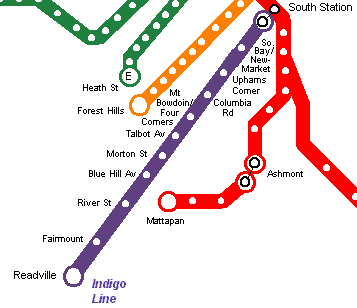
I had sort of paid attention, but not enough, to the news over the years. This has been percolating for nearly two decades and is happening as we speak. I'll post details in a few days. However, the key concept it that Martin led largely African-American Bostonians between lower Hyde Park and South Station in indignation. A perfectly good commuter-rail line zipped through their neighborhoods, making the trip in 8 minutes. Read carefully to be fully aware that it made two stops on the way (Morton Street and Uphams Corner). In fact, there were no other stations for it to stop at over 8 miles, by design, where most people lived.

The bus or bus/subway alternatives for this large swath inhabited largely by lower-middle, poor and middle class residents of color was different. It took an optimum 45 minutes and more likely 60 to 90 for the same trip from where people live to where they work. There are four stations (New
Market/ South Bay, Columbia Road, Four Corners, Talbot Avenue, and Cummins Highway) \in the works in an activists' effort that started in 1987 and has continued relentlessly.

pigI must be a typical American. I paid attention when it meant something personal. Moving to Fairmount Hill in Hyde Park after 21 years in Jamaica Plain, I was pleased to hear from the previous owners here that the Fairmount line at the bottom had a commuter rail. In a pig's eye it does.

Until the Indigo line is complete and the MBTA keeps its promise to increase trips, it is still a white commuters' line. Specifically, inbound, four trains are scheduled for Fairmount between 6:38 and 8:28 a.m. Likewise, outbound, there are four from South Station from 5:10 to 6:30.

Throughout the day, a few may stop if the conductor notices anyone flagging the train from the platform. The last possible train from South Station leaves at 9:30 p.m. and will stop to discharge only if passengers ask the conductor and that conductor remembers to tell the driver.

Weekends? Forget about it!

Moreover, this in unlike a real city transit system for pricing. With a Charlie Card fair of $1.70 for subway and $1.50 for bus, the irregular and inconvenient Fairmount is $4.25 each way, with no provision for transfers, even to buses.

I figure to go to Mike Capuano's function Monday at the Park Plaza from 6:30 to 8:30 p.m. That should be a good time to see how to get from here to there and perhaps even back.

First, note that the MBTA trip planner truly stinks. On Universal Hub and numerous blogs, they have depressing examples of being routed absurd ways to go short distances. In this case, I also found the T doesn't use fuzzy logic and requires silly specifics to find the most basic locations. For example, it can't find Back Bay Station without its ZIP code added, and it knows Milton Ave., but not Milton Avenue, but again only with a ZIP and not just the neighborhood. Lame.

For giggles, I asked about getting to and from the event. By the bye, the number 24 bus through Mattapan Square and up to Ashmont stops a half block from my house. The T doesn't seem to know that.

The T would have me spend $5.95 each way, with trip times from 63 to 97 minutes. Those using the commuter rail also indicate a flag stop for the train, which I don't trust from previous experience seeing trains pass vigorously waving potential passengers.

future Indigo Line

I know from a son who commutes to Latin Academy that a shank's mare version is quicker. A 10 or so minute walk to Cleary Square get a 32 bus in a minute or five, for $1.50. I gets to Forest Hills in 15 to 20 minutes. Then the Orange Line thumps to Back Bay Station in a similar time, for $1.70. So, for $3.20 and under an hour, I'd be done each way with a vastly more flexible schedule than any of the combinations the T suggests.

Were I still on crutches from my leg operation earlier this year, I'd do the 24 close by. I could take it from very close to Ashmont, then the Red Line subway to the Orange Line and get off by the hotel. That would be maybe 90 minutes, or T time.

In other words, it's expensive and slow, practically mandating a car trip with a pocket of quarters and driving around Back Bay for an open meter. That would be when people are leaving so it wouldn't take long.

That's not as significant as the many thousands who live between the Orange and Red Lines with no viable commuter rail. It is inconvenient and unnecessarily expensive.

I think of the much larger, longer, wide and more stop-filled NYC subways. In Manhattan alone, you can travel the 14 miles from the Battery North to Washington Heights local or express and get damned close to where you want fast. The city fare is $2.25 and trains go from where people live to where they work and play. All lines run all the time, frequently and on weekends as well.

Back to Boston and down to earth, we're never going to be a 24-hour city or have a fast and frequent subway system. However, we can do better.

Through the efforts of Martin and the CDCs, the Indigo Line is coming. I remain to be convinced that the schedule will be convenient. I'd love to be able to go into town day and night on a convenient line.

There's no reason other than inertia or indifference by the T that we don't have real urban transit. There's also no reason other than arrogance why its zone system puts so many parts of the actual city of Boston in zone 1 at $4.25 for what should be the same as a $1.70 subway ride. Absurd and provincial.

Of course, for the upper middle and upper class commuters, these are not problems. The trains run at to- and from-work times. They buy commuter rail passes so they don't feel the per-trip cost. All the rest of the riders subsidize them and make do with the few off-rush-hour trains.

I see a parallel here with computer software. Most of it requires that the users be programmed for the quirks of the applications. We had to learn absurd commands and procedures to do basics. Likewise, T riders are supposed to adapt to the T's edicts and caprices.

We oldsters and early adopters recall illogical Ctrl-k sequences for Word Perfect and such. Here, we're accustomed to transit that just stops at night, trolleys that can't operate over fallen leaves, and commuter rail that doesn't accommodate where people live or when they want to arrive.

That future post will discuss how a indefatigable set of activists changed that for the Fairmount Corridor. At Rail-Volution, attendants from around the country could not stop raving at how sophisticated and effective that effort has been. It gives a Bostonian hope

Tags: , , , , , , , ,

Monday, November 13, 2006

Listen Up, Deval

Small to moderate efforts can bring huge paybacks. Deval Patrick has some opportunities in January to show what a directed and moral governor can make happen.

That's something many of us have forgotten over the past years of stagnation.

Patrick made repeated promise of fundamental change to governance and infrastructure. If you have not read and reread his promises, do try his campaign policy book.

We propose three biggies he and the legislature can knock off quickly and we'll all be much, much better for their accomplishment. They'll also set the tone of the possible and the right.

Let's not forget that with a rudderless government -- both in the executive branch and the legislature, particularly the senate -- lawmakers seem to think their only job is pork for their districts, so they will get re-elected. They need kicks in their collective butt to get back to the business of the commonwealth.

Deval, listen up. We strongly suggest:
  1. Fully legislate gender-neutral marriage
  2. Return initiative petitions to their original purpose
  3. Revise MBTA loan structure and forward funding to reality

Marriage

The governor was the babbling baby in the corner and the legislature was paralyzed without meaningful leadership. Hey, all, the Supreme Judicial Court told you that marriage equality was the only thing compatible with our constitution. They said, "Make it happen."

So, make it happen. Settle this damn thing finally. This is a small subset of laws that will fully formally enact the necessary rights. You've had years to fix it. This should be the top quick-hit of the new administration.

This will reinforce not only the constitutional interpretation of the highest court, but the repeated votes of our legislators already and the public view in which 60% or more want this. It should also stop those divisive type who can't get on with their lives. Maybe they can move to New Jersey and cackle there.

Ballot Initiatives

We are only one of many states where citizen redress of initiative petitions have been hijacked by the hateful and self-interested. Fine-tune them. Fix them. Return them to their original purpose.

In case you forgot, they exist to give the public a way to correct crazy and detrimental legislation. They are not to foster business interests, nor to legalize theocratic precepts, nor to deprive groups of citizens of civil rights, and certainly not to the overrule court decisions.

The nasties have seen what they can do with sleazy money and dishonest tricks of campaigns. We don't need unfunded mandates. We don't need narrow political interest and religious groups sneaking their self-serving laws on us under the guise of helping the public.

This will require a little study, but not much. The issues are clear. The lessons of the recent ballot drives are all we really need to study.

Mass Transit

Forward funding was a colossal blunder. Fix it.

At a time when it is plain we need more people taking public transit, we hike the fees yet again and repel riders. We need fewer cars, less pollution, and decreased congestion and accidents.

Instead the dull-witted T board and the inert legislature saddled the T with crippling debts. It cannot meet the legal requirements forced on it and serve the public.

Forward funding's basis is income that we did not and shall not get. It is dishonest and a sure loser. Any business, or well-managed government, would revise a major funding scheme when it became plain it was unworkable.

Don't doom the T. Remove the debt, so that it can operate at break-even. Deval is smarter than Romney. He can lead the laddies and lassies of the legislature to this quickly and with business savvy.

Tags: , , , ,

Wednesday, August 23, 2006

Death in the Shadows

A few days ago when I was speaking with the well respected Boston cop who lives a few doors away, he said in passing that the Department would use all the good press it could get. Looking at city officers who apparently were drug couriers and dealers, he's right, of course.

Secrecy don't help though. Nor does the lickspittle attitude of the Boston Globe.

In a city increasingly discomforted and fearful from climbing murder rates, we should be rallying around the men and women who put themselves between violent criminals and us. As one manifestation, today's Globe carries a report of a lawsuit demanding full staffing to 2,500 officers per a 1979 City Council ordinance.

Yet this is just the time for transparency, honor, honesty and building public trust. The old way was to whistle and look skyward as bodies disappeared. It's our version of don't ask, don't tell. That has been true of both the BPD and the Globe.

Let's take a couple of instances recently. One was last week when an off-duty officer plowed into a stalled car on 93 early in the morning, killing the occupant. Another was a few weeks ago and only secondarily the BPD and primarily the MBTA police when a man died on the Orange Line tracks.

In both cases, the Globe seems to rely entirely on handouts or press commentary from the police departments. It didn't follow up or do original reporting beyond these.

In the first example, as reported in the Globe Officer Thomas M. Griffin, 27, will not be charged for killing Michelle L. Vibert, 29.

Of course, imagine if a private citizen had been tooling up I-93 pre-dawn and did the same. The likely consequences would have been:
  • Testing for alcohol or other drugs
  • Charges for reckless driving or worse
  • Tear-producing coverage of the victim
  • Details on the actual wreck and related conditions
  • Follow up articles
Instead, we have:
  • Boston's Acting Police Commissioner Albert E. Goslin calling this simply "a tragic accident"
  • State Police not explaining why the victim's car was in a travel lane or whether it's lights or blinkers were on
  • State Police deciding not to file any charges
  • No mention of any effort to test the officer
  • The Globe not asking any meaningful questions for doing any follow-up coverage on what for all the world looks like a buddy cover-up
Dan Kennedy's Media Nation got a related comment on this wreck:
island_earth said...

When I saw your subject "In the breakdown lane," I thought you were going to address yesterday's horrendous Globe article Off-Duty Officer at Wheel in Crash somehow. The entire article describes how an off-duty police officer hit a woman's car that was parked in the breakdown lane, killing the woman, and he won't be charged. Heaven forbid the reporter would ask *why* he won't be charged, leaving it to the reader to assume it's because he's an off-duty police officer. Which may well be the reason, but you'd think the reporter would try to get someone on the record about that one...
Indeed, it is more understandable that police would like such incidents to disappear without examination than for the major local daily to do so. If the reporters have no guts or gumption, don't they have any good editors over on Morrissey Boulevard?

Likewise for the Orange Line death. We know only the barest details and neither the MBTA nor the Globe seems to have any inclination to flick on the light.

Some guy was on the tracks near Green Street. He died either from getting hit by a train or hitting the third rail. The Globe ran the press release and the short one later giving an unlikely name for the victim. ...nothing else.

By the bye, the Herald hasn't done squat with either story. They are badly understaffed and never ran with either. So their faults are less. Their days of excellent crime and death coverage are long behind them anyway.

A local daily should be all over these. Do we have a police cover-up? Is the Orange Line death an anomaly or does it point out station/track safety concerns? What of the human interest aspects of both victims? Will the Globe only follow up on the I-93 wreck if a wrongful-death suit comes to courts? (At least then they could get a press release to run and avoid any actual reporting.)

I am out of J-school and am appalled by the Globe unprofessional behavior on these and other such stories. Again and again, I read them and wonder why they didn't ask the obvious questions. Isn't there a single metro reporter who understands what makes a good story and what readers expect to learn from one?

From both cases, neither city, transit nor state police help their causes by ignoring these cases. Most certainly the Globe has failed again and again. Let's see them put the news in newspaper!

I have sent email to our daily asking for coverage of the Orange Line death. They did not reply and I don't expect them to. Of course, if a dozen or so folk asked why they are running press releases instead of telling us what is happening in these and similar cases...

If the editors are pulling the cover back up over their heads, perhaps the ombudsman might be awake.

Tags: , , , ,

Tuesday, June 06, 2006

MBTA Boycott, Not

If you decided to honor the T boycott against fare increases call today and walk or bike to work, it'll do you good. On the other hand, the boycott organizers very belatedly bowed to those who said it was dumb -- too many people are not within non-mass-transit reach of work.

Regardless, the last Boston hearing is today at 4:30 to 6:30 p.m. at the Copley library. The no-longer-boycott folk will hold a brief rally (4ish?) before the hearing.

In other news, Deval Patrick announced that he was against the proposed fare hikes as "poorly timed" and impractical. He told the Metro by phone, "When gas prices are at $3 a gallon, and wages are stuck in neutral, itÂ’s a hardship on working families who commute to raise fares. WeÂ’re not talking about a couple of pennies. WeÂ’re talking about a big jump."

Fellow gubernatorial contender Chris Gabrieli's spokesman, Dan Cence, said his man agreed. The Metro couldn't get the other three candidates.

Tags: , , , ,