Showing posts sorted by date for query mbta. Sort by relevance Show all posts

Thursday, February 27, 2014

Falchuk pitches himself as smart, brave reformer


Ready for a new political party in MA? Well, Evan Falchuk is.

Ancillary stuff: He secured Political Designation status for the United Independent Party (UIP). The link on the Secretary of the Commonwealth's site goes to Falchuck's campaign one. By the bye, a designation requires signatures from 50 registered voters, does not require any number or percentage of votes cast to continue, and its members may not vote in a primary. However,  in theory, if a candidate for governor met the stringent requirements, public-financing matching funds would be available.

We at Left Ahead are dickering with his folk for a chat. Meanwhile, he appeared at Suffolk Law's Rappaport Center roundtable and has a campaign site.

At Suffolk, he stood out for several obvious reasons. He has a great shock of dark hair, perhaps suitable for one of the Hong Kong Cavaliers in The Adventures of Buckaroo Banzai Across the 8th Dimension. More meaningful though, he is a personable campaigner. Unlike the typical of these roundtable guests, he did not arrive just at the 12:15 PM showtime. Instead, he worked the room, introducing himself, shaking hands and encouraging interaction.

Smart, brave reform

Placing himself in a netherworld — below the support and primary risk of a party, and separate from an independent candidate per se — Falchuk stands out with a good theme. I enjoy a sharp slogan and he delivers with smart, brave reform.

His platform on the campaign site details all that comprises. That theme lets him weave all related topics back to it. He also showed his one true routine of snark at the roundtable after starting with saying he was like other voters in being tired of having to choose the lesser of two evils. For motivation, he said, "When I go and I see candidates say why they are running for governor say, 'I'm ready' or 'I want to prove that I an redeem myself from some prior failure,' I say, 'That's interesting for you, but what does that have to do with any of  us?'"

His reform refrain goes to three key areas — politics, economy, and government. He gets to play the populism card in each area.

For example, in campaign finance, he definitely is in the money-is-not-speech clique. That includes a Constitutional amendment, in effect voiding Citizens United. For this commonwealth, he cited what he says is a built-in 15:1 advantage for big-party candidates. That is, the laws and regulations allow $15,000 per year per candidate for party folk and $1,000 for others, including him and his UIP. He calls this "a corrupt system."

For taxes, we are one of seven states with a flat tax. In our case, it is in our constitution (Article XLIV). He calls it "inherently regressive when it comes to the disposable money people have." He'd like to see an amendment changing that, plus a tax-modernization commission to update MA to a 21st Century tax code.

Refreshingly, he did not push the stereotypical fraud-waste-and-abuse buttons on spending. Instead, he said much of MA's money was misallocated. He cited such areas as funding for the homeless, and pledged a line-by-line examination of where money went.

On transportation, he had a couple of strong statements. For one, the train tracks in the Pioneer Valley were now straightened out and good enough for Amtrak. He'd like to see commuter trains moved there as the MBTA replaces them, to be used for local transit out there. For another, he's big on the South Coast rail project. He said it "has become a political hot button issue. It ought not be. We should go ahead and build it."

Health-care costs were as big an issue with him as with other gubernatorial candidates. He had a different view of the root of the problem — the continuing consolidation of hospitals into big systems, which then set prices as suits them. He took AG Martha Coakley and the whole Democratic administration to task for watching this happen and doing nothing. He pointed to the current effort of Partners to take over South Shore Hospital. He would like to stop that and decrease the geographic monopolies here.

He also noted that then Gov. William Weld and Charlie Baker (current candidate for governor and Weld's Secretaries of Health and Human Services and Administration and Finance) deregulated the health-care industry. That, Falchuk, says has led to 72% of market being controlled by a few health-care systems.

Not coincidentally, among his credentials is the past 13 years in executive positions at Best Doctors, Inc.

In education, he was the same and different as other candidates. He sees too much emphasis on teaching to standardized testing. He thinks government has a role in making sure kids get the skills they'll need from school. Where he diverges is in what he thinks students should come out of schools with, including:

  • independence
  • resilience
  • critical thinking skills
  • grit
  • knowledge that they can overcome obstacles

Those of course are much harder to measure than math proficiency. Those goals like so many he cited would require presenting them to a smart group of advisers, legislators and officials to ask the best way to get to them.

Getting there

Falchuk is relentlessly optimistic and enthusiastic. He definitely counts on his populist message to suck in voters. He noted that America from the beginning was "an experiment in government." He listed the problems and possible solutions, concluding "There is not a king or queen who's going to come down and do it for us. We have to do it."

To the obvious question of where he expects to find victory, he quipped that he only had "to get more votes" than the other candidates. He said he expected to go out and earn them, to convince voters in all his appearances that he could achieve what they all want.

For the two major parties, he added, "I never think of it as taking votes from anyone. I have to earn every single vote."

From my distance, I surmise that the future of the UIP and whether it will exist apart of Evan Falchuk depends entirely on how he pulls in November.


Wednesday, August 31, 2011

Greenway Going Great

Hail to the many who have worked for the better part of two decades for a Neponset River Greenway! Within two years, the biggest missing piece will be complete. Citizens, engineering sorts and bureaucrats alike have 'er done.

I joined what looked like a little over a hundred in the Foley Senior Center on River St. in Mattapan last evening for another quenching trip to the well. You can grab the straight coverage and a link to the presentation at the Dorchester Reporter. You can also search at that site for excellent past coverage on this trail.

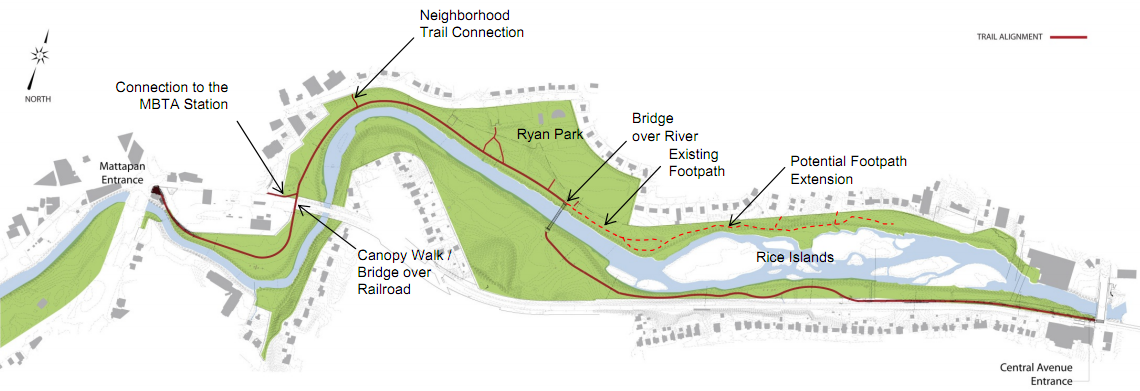
The short of it is that after many meetings and laborious compiling of complaints, suggestions and comments of Milton, Mattapan and Dorchester abutters (and numerous whiners, loudmouths and cheerleaders), the final plan looks like a winner. A large majority apparently love it. It moves from conceptual drawings to engineer docs that can aid in getting the federal money for the project as well as giving the nitpickers and Myers-Briggs S types something to hold and come to terms with happening. They are now figuring that completion of a link from Central Avenue into Mattapan Square for a ped/bike path will happen by the fall of 2013.greenplan

Click the pic for a closer view or go to the presentation for it and the earlier schemes. Key aspects are that it starts at the existing path at Central Avenue, runs between the trolley path and river, crossing from Milton to Mattapan on a new bridge by the Ryan Playground, then curves on the north of the river to a new ped/bike bridge over and around the trolley terminus and into Mattapan Square.

This came after five previous plans. After the public meetings and private comments, which the presentation recaps in concepts and numbers, the latest plan seemed to placate nearly everyone.

I came for the details, but left with a felt sense of the democratic skills involved, particularly the the DCR folk in managing a prickly, often nasty process. While he was quick and frequent to spread credit and praise, the diplomat in chief seems to be Jack Murray.

The DCR Deputy Commissioner for Park Operations is unfazed by the hostile, NIMBY and unfair-to-me types. Even at this largely jovial celebration, several dissatisfied folk spoke out and up, without rattling Murray. He's been though a couple years of rough democracy on this and kept his cool and his smile.

In fact, several of the pols who attended and chimed in their praises (Sen. Brian Joyce and Reps. Linda Dorcena Forry and Russell Holmes) called the process out for its amazing transparency, flexibility, and outreach. There was passing mention of the contention involved from the beginning, and nothing but kudos for a thoroughly open process — perhaps an inspiration for the larger government, ask I?

Murray was also charmingly coy about the MBTA. It refused to allow an at-grade crossing for the trail, leading to among other expensive problems, a ped/bike bridge at Mattpan station. Murray just smiled and said "We love our sister agencies."

So it's worth nothing the residual complaints that bring up what the DCR and the many others involved overcame. Last evening lacked the whiffs of racism and classism noted in articles about earlier public meetings. A few of those seemed to mirror the fears that kept Weston from allowing an extension of the Minuteman path. There was only one of those last night, and of course Murray handled that well.

Despite the round praise for the proposal, one resident still wanted her say, there and in some private meeting. It was a wonder to hear. She said the trolley runs behind her house and the bike path will. Her concern was that cyclists would jump the fence and do something nefarious on her property - to her possessions or daughter. Hearing that it doesn't happen, not in Boston or Lexington, and that bike paths add light and witnesses, making areas safer was not enough. She didn't seem to notice that she undercut her argument by saying she feared the same of the nearby trolley. The fact that this has never been a problem did not deter her. She wanted some kind of meeting with state officials and not a public one. Meh.


Toward the end of the question-and-comment period another resident tried the it's-only-a-start ploy. He's surely sadly mistaken if he supposes something with this much pubic input and accommodation awaits his brilliant revisions and a restart.

Otherwise, the niggles were indeed niggling. People were pleased at the result and particularly at having been listened to. They could see their suggestions, complaints and fine-tuning before them. The Neponset River Tail Phase II is rolling right along.

Duplication note: Being both bike-personal and political, this is a cross-post from Harrumph.

Wednesday, September 22, 2010

Tranquil, Tense, Tight, Trivial on Your Very Stage

Kiddies, the penultimate not-really-a-debate last evening was unsatisfying. GOP Charlie Baker looked again like Bibendum the Michelin man and acted like the irritable lord of the manor. Independent Tim Cahill maintained his workingman persona but was strident and even whiny attacking Baker. Green-Rainbow Jill Stein seems lost in detail, unable to present a vision. They left Dem Deval Patrick as the calm, rational, firm one.

Host site WGBH surely will run the quarreling quartet show on its campaign page in a day or two. Meanwhile, the four campaigns are pointing to this or that minor edge, as are partisan papers and bloggers. I can't believe anyone sitting thorough this awkward hour switched allegiance.

As a disclaimer, I am no fan of the current debate-like-spectacles. They aren't debates and rob us of any real chance to get insight or even a real sense of how candidates might behave in the wilds of office. Narrowly focused, too often stereotypical questions and short answers are feel-good, think-little ploys. We need some serious debates, in which savvy, well-prepared, strongly opinionated candidates go at each other for hours, with real substance as the result. As in the previous three centuries, the voters don't have to be there or even stay awake and alert for the whole debate. The press and others cover it and reveal the resulting treasurers. These forum-style staccato exchanges don't help us.

Unfortunately, the second half hour did not show the four's superpowers. They each had chances to ask a question of one, just one, of the others at a time. Of course, they knew well in advance this would happen and supposedly applied their own and their advisers' brains to the task. Small brains brought small questions.

They need to work more crossword puzzles and perhaps meditate and daydream. These questions were chances for big victories. The four managed schoolyard taunts and efforts to embarrass instead. For perhaps the worst example, Stein brought went into the political recycling bin to pull out —ta da — tax incentives for big companies who promised MA jobs but didn't deliver. This gave Patrick a big one, the chance to point out that his administration had changed the former way of handing out incentives by adding giveback (claw-back in current lingo) terms to retrieve the money if the companies don't deliver.

As another aside (a.k.a. mini-rant), we could use Grace Ross in this race this year. Yes, she has often seemed odd and few even fantasized she could have won running for governor. Her huge plus was that she made the debates with big, pointed questions that could not be smothered with talking points. She was maieutic in the classical sense, prompting all the candidates to deliver real thinking and solid ideas. No one on stage did that or is likely to in the next and final debate-like-thingummy.

Where's the Beef?!


The first candidate to speak (by draw) was Baker, who proved himself a windbag for the whole hour. I fear this really is a class/culture issue and he can't help himself. Even though Patrick is a rich man as well, the Gov. has a believable humanity that Baker does not. Instead, he has the mien of the master. He clearly is accustomed to deference from underlings.

Unfortunately for him, no one on stage was his lackey last night. Moreover, he not only has an irritating habit of iterating "at the end of the day," but he only had a couple of talking points. For example, he fixated on "unfunded pension liability" when assailing Cahill.

Perhaps that was both a slur and an attempt to make Baker seem fiscally knowledgeable. Instead, I suspect most voters likely think how bad is that and what does that really mean. In fact, Cahill got to return that the Republican administrations left him a weak, smallish set of pension funds, which he has handled superbly, growing at record pace. Yet Baker returned to this, likely because he had little else.

Amusingly and as the Globe analysis notes, Baker tried repeatedly and failed repeatedly to paint Patrick and Cahill as co-conspirators in raising taxes. In the end, this ill-conceived ploy probably helps keep Cahill's asthenic candidacy viable, elevating him to powers he didn't have.

Fortunately for Patrick, many viewers are likely to remember only that Cahill called Baker a liar several times, using that word. Baker had unconvincing responses, while maintaining his level of pomposity.

Unfortunately for Baker, he also did nothing to remove the sense that he won't come clean about his role in the Big Dig and other Weld administration finance disasters. These continue to bedevil all of us in neglected infrastructure and hobbling debt service, including on the turnpike and MBTA.

So far, Patrick has stopped short of alleging that Baker colluded to hide the pending cost overruns and massive obligations from the Big Dig. He'd have strong arguments if he chose.

Stein remained somewhat spacey throughout. She just isn't a vision person. Her emotions may be in good places, but she did nothing to suggest she has plans and abilities to implement them.

Patrick apparently isn't going to look for a rout in November, just a re-election. His remaining cool and knowledgeable seems to be getting him there.

Tags: , , , , , , , , ,

Tuesday, August 31, 2010

LITE Right Williams

The noble, highly useful busybodies at JP Progressives have been flogging their legislative forum series...and with good reason. I had noticed highlights of the 2nd Suffolk Senate District and finally dug into the 19 questions, plus 12 yes-or-no lightning round ones.

The geographically sprawling and diverse district includes the Back Bay, Beacon Hill, Chinatown, Dorchester, Jamaica Plain, Mattapan, Roxbury, and the South End.

There's a PDF doc of the questionnaire and all Senate and House candidates in the series here.

It's no secret I have supported the incumbent Sonia Chang-Díaz and endorsed her from her first go at the office in 2006. She didn't make it that time, but did two years later. Dem challenger Hassan Williams would have to show some real stuff to change my mind. He doesn't have it.

I recently moved from the district. I still endorse Chang-Díaz. In fact, with her impressive accomplishments in her first term, she has already shown that being new at the job has not been a problem. I expect even better from her in future years.

You can compare their campaign approaches on their sites:
There's a strong contrast, some from the most obvious factors. She has a legislative record of bills introduced and some passed. He has never held office. She has a detailed platform. He has small, scattered ideas.

It would be glib to say his only record is one in the criminal justice system. His sites don't detail or stress earlier legal troubles long before he became a lawyer. In stump speeches tough, he says he can identify with youth and adults who come into bad habits and times. While was a leader in getting long-overdue CORI reform passed, she can't claim to have an arrest record.

His take on her legislative accomplishments has been unfortunate. In numerous public and press statements, he calls her work plagiarism and claims she only followed up on what previous Senator Dianne Wilkerson started. Unfortunately for his argument, Chang-Díaz actually got the work done, collaborated with other progressive sorts to get key bills that languished in bill stages and committees for many years. He has nothing comparable to suggest he could have done nearly as well much less better.

Keeping it too simple


To the JP Progressives, there's also two hot buttons for me as well as a similar contrast in the candidates' positions. Generally, he clearly hasn't noodled the issues too thoroughly. Where he does state positions, they tend to be much more literal and simple than would befit their complexity.

For example, on the environment, his three priorities would be:
  1. Wind and clean energy technology reducing demand for oil
  2. Reducing emissions, and
  3. Protecting our trees and air quality by planting as many new trees as possible.
She can be specific with references to stuff in her pot:
  1. I will continue to fight for bills like SB388, which I filed this session, that would help identify communities in Massachusetts that suffer disparate health outcomes due to environmental pollution and require certain projects to complete a health impact assessment before approval. Such a measure is a vital first step in ensuring environmental justice for all our communities.
  2. I will co-sponsor and advocate for the passage of expanded bottle bill legislation.
  3. I will continue to fight for improving the financial solvency, scope, accessibility, and environmental impact of public transportation, through revenue reforms including an increased gas tax.
In addition to these specific priorities, I will continue to
work on broader strategies to improve our environment,
increase economic justice and promote alternative energy
and green business, whether it be through alternative energy,
green building, or combinations of the two.
It was similar with the other big issues, like transportation and education. She had specifics and a vision. He was LITE with concepts or something simple. He wants respect for riders from the MBTA, a prettier Dudley station, and more traffic studies that, he claims, will lead to more on-time rides. She addresses improvements that would equalize service to areas of different income level.

Pushing buttons


A couple of rights questions got my attention as well. On a women's right to reproductive choice and same-sex marriage, Chang-Díaz is unequivocal. She strongly supports both. Williams looks reactionary on choice and avoids SSM.

The questions were:
Many states, including Massachusetts, have enacted or proposed barriers to women seeking to access an abortion—from waiting periods to mandatory ultrasounds. Would you oppose any additional legal barriers to women seeking abortion services in Massachusetts?

Do you support same sex marriage?
She replied to each YES. Note that the SSM one was a lightning round, requiring a yes/no answer.

He equivocated on both. For choice, he replied:
A woman has a right to choose whether or not to become pregnant. A child has a right not to be violated. Any conversation that disregards the right of either one is unconstitutional. It is not enough to respond that one is pro choice or not. The conversations must run deeper, looking at every unique situation. Every measure should be taken to honor the right of both whenever possible.
For SSM, his answer was:
Same sex marriage. I believe same sex marriage is well settled law in Massachusetts, and I will not do anything to change that status.
The first one seems suspect and reactionary to me. As an attorney, he should know that early stages of a fetus are not a child, whose rights might be violated. Equating the woman's rights is asinine. It smacks of a strong bias that he doesn't quite have the guts to proclaim.

Likewise on SSM, suggesting that he wouldn't try to undo it here is not the same as active support for existing rights. Together those answers sure look like a fundy hiding behind weasel words. If those are religious issues he can't get over, he ought to speak out on them.

I suggest reading through both candidates' responses. There's a progressive actually doing the work, ready to dive back in for another couple of years of it at least. Then there's the LITE and right guy who implies he could do better, even though he doesn't have a vision or a program.

Tags: , , , , , , , ,


Tuesday, March 02, 2010

Dukakis Gets Real on Rail

The Duke feels strongly about mass transit and intercity rail. Speaking with us on Left Ahead! today, he was delightfully candid and brimming with specific fixes.

Click the player below to hear the whole show. Head to Left Ahead! or iTunes to download the mp3 file.

Among his analysis was a solution to the crippling debt of our MBTA system. The legislature and previous Republican governors had linked our mass transit's fiscal health to a supposedly endlessly growing sales tax cut. That failed and was a terrible blunder, according to former Gov. Mike Dukakis.

He said he desperately need a workable mass transit. "If you want a first-class public transportation system, you got to pay for it," he added. His more rational solution is adding 6¢ to 9¢ to the long stagnant gas tax, devoting it to the T and commuter rail.

In addition to stopping the every-few-year rises in fares and garnering the huge environmental and other obvious benefits of fewer cars, he sees another huge plus. Maintaining and expanding the various rail systems would create thousands of good-paying jobs at at time we need them most. He cited the 10¢ gas tax bump when he was governor. His administration, he said, "turned it into a jobs bill, which it was."

Listen in to hear what he likes and dislikes about the current efforts. See also his co-authored piece on transportation reform that appeared in the Boston Globe. He has a very different take on the best way to manage it all, which he explains in the podcast as well.


Cross-post note: I'll duplicate this at Harrumph!

Tags: , , , , , ,

Tuesday, November 17, 2009

Act Now on MA Transportation Podcast

“The days of highway expansion in Massachusetts are over,” declares James Aliosi, who stepped down last month as Secretary of Transportation. He said now is the time to act and particularly to level the playing field by developing passenger rail and public transit.

In our podcast today, he ticked off such benefits as sparking industrial development and job creation, improved public health and safety, and increased energy security. He figures that the federal government under President Barack Obama is ripe for aiding just such development. What we need here is a coalition of the affected group in all those areas, including transit specific, health, our legislative and executive branch leaders, energy and more.

We discussed some of the key issues in his 12-page exit letter he sent to Gov. Deval Patrick. These include funding rail projects, getting the MBTA solvent, shaking votes and funding from the legislature to enable transportation improvements, and making multi-modal transit practical for all of us.

Aloisi is not shy about proposing innovations. He’s a proponent for VMT (vehicle miles traveled) payments, as proven in other states. That is big here, where the legislature is frightened of raising the gas tax to pay for existing highway needs, much less 21st Century problems. He also talked about the leadership and support he had from Lt. Gov. Tim Murry on making commuter and freight rail real and viable for us.

Podcast note: Click the arrow to play. Go to Left Ahead! to download.


He calls for courage and leadership. Those should be on the part of the transportation and other activists he worked with and hoped to empower as secretary. Also that would be our governor, lieutenant governor and a cadre of state and U.S. legislators who are champions of these goals. He also named commonwealth mayors who already fight for improved transit and equitable funding. He says that the public really hasn’t been broadly sold on this shift, but that they are hungry for such change and for the leadership to get us there.

We dealt with funding issues, which are at the core of many of our transit woes here. He has no patience with what he calls the gimmicks, like refinancing unmanageable T debt. He calls that delaying the day of reckoning and hiding the problem so the the public isn’t aware of it and our lawmakers don’t have to deal with it. Instead, he said there needs to be a restructuring of that debt (including relief of the $2 billion Big Dig portion laid on the T, with that VMT and some combination of sales-tax allocation to make the system workable).

He calls for public pressure and now, not in five or two years. Listen in as he talks about what has to be done. Many progressives can bring these issues to their own organizations and be part of that catalyzing coalition he envisions.

Cross-post note: This appear at Left Ahead! and Blue Mass Group.

Thursday, November 05, 2009

Boston Commuter Rail Rant

The charm quickly peels awayfrom Boston's atavistic transit system. Like the crappy Pennsylvania Turnpike, we have the hemisphere's oldest subway. It seems like it.

Series note: This is part of the Rail-Volution inspired post set.

At the weekend's conference, I was surprised and pleased to learn about the Fairmount Corridor from two key players. Marvin Martin, who drove this city-train revolution as executive director of the Greater Four Corners Action! Coalition (no website) and Gail Latimore, who heads the Codman Square Neighborhood Development Corp., spoke.

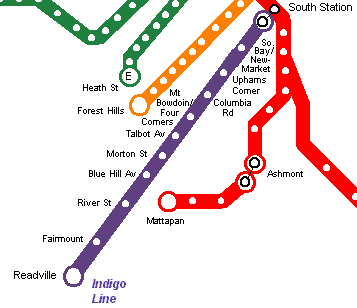
I had sort of paid attention, but not enough, to the news over the years. This has been percolating for nearly two decades and is happening as we speak. I'll post details in a few days. However, the key concept it that Martin led largely African-American Bostonians between lower Hyde Park and South Station in indignation. A perfectly good commuter-rail line zipped through their neighborhoods, making the trip in 8 minutes. Read carefully to be fully aware that it made two stops on the way (Morton Street and Uphams Corner). In fact, there were no other stations for it to stop at over 8 miles, by design, where most people lived.

The bus or bus/subway alternatives for this large swath inhabited largely by lower-middle, poor and middle class residents of color was different. It took an optimum 45 minutes and more likely 60 to 90 for the same trip from where people live to where they work. There are four stations (New
Market/ South Bay, Columbia Road, Four Corners, Talbot Avenue, and Cummins Highway) \in the works in an activists' effort that started in 1987 and has continued relentlessly.

pigI must be a typical American. I paid attention when it meant something personal. Moving to Fairmount Hill in Hyde Park after 21 years in Jamaica Plain, I was pleased to hear from the previous owners here that the Fairmount line at the bottom had a commuter rail. In a pig's eye it does.

Until the Indigo line is complete and the MBTA keeps its promise to increase trips, it is still a white commuters' line. Specifically, inbound, four trains are scheduled for Fairmount between 6:38 and 8:28 a.m. Likewise, outbound, there are four from South Station from 5:10 to 6:30.

Throughout the day, a few may stop if the conductor notices anyone flagging the train from the platform. The last possible train from South Station leaves at 9:30 p.m. and will stop to discharge only if passengers ask the conductor and that conductor remembers to tell the driver.

Weekends? Forget about it!

Moreover, this in unlike a real city transit system for pricing. With a Charlie Card fair of $1.70 for subway and $1.50 for bus, the irregular and inconvenient Fairmount is $4.25 each way, with no provision for transfers, even to buses.

I figure to go to Mike Capuano's function Monday at the Park Plaza from 6:30 to 8:30 p.m. That should be a good time to see how to get from here to there and perhaps even back.

First, note that the MBTA trip planner truly stinks. On Universal Hub and numerous blogs, they have depressing examples of being routed absurd ways to go short distances. In this case, I also found the T doesn't use fuzzy logic and requires silly specifics to find the most basic locations. For example, it can't find Back Bay Station without its ZIP code added, and it knows Milton Ave., but not Milton Avenue, but again only with a ZIP and not just the neighborhood. Lame.

For giggles, I asked about getting to and from the event. By the bye, the number 24 bus through Mattapan Square and up to Ashmont stops a half block from my house. The T doesn't seem to know that.

The T would have me spend $5.95 each way, with trip times from 63 to 97 minutes. Those using the commuter rail also indicate a flag stop for the train, which I don't trust from previous experience seeing trains pass vigorously waving potential passengers.

future Indigo Line

I know from a son who commutes to Latin Academy that a shank's mare version is quicker. A 10 or so minute walk to Cleary Square get a 32 bus in a minute or five, for $1.50. I gets to Forest Hills in 15 to 20 minutes. Then the Orange Line thumps to Back Bay Station in a similar time, for $1.70. So, for $3.20 and under an hour, I'd be done each way with a vastly more flexible schedule than any of the combinations the T suggests.

Were I still on crutches from my leg operation earlier this year, I'd do the 24 close by. I could take it from very close to Ashmont, then the Red Line subway to the Orange Line and get off by the hotel. That would be maybe 90 minutes, or T time.

In other words, it's expensive and slow, practically mandating a car trip with a pocket of quarters and driving around Back Bay for an open meter. That would be when people are leaving so it wouldn't take long.

That's not as significant as the many thousands who live between the Orange and Red Lines with no viable commuter rail. It is inconvenient and unnecessarily expensive.

I think of the much larger, longer, wide and more stop-filled NYC subways. In Manhattan alone, you can travel the 14 miles from the Battery North to Washington Heights local or express and get damned close to where you want fast. The city fare is $2.25 and trains go from where people live to where they work and play. All lines run all the time, frequently and on weekends as well.

Back to Boston and down to earth, we're never going to be a 24-hour city or have a fast and frequent subway system. However, we can do better.

Through the efforts of Martin and the CDCs, the Indigo Line is coming. I remain to be convinced that the schedule will be convenient. I'd love to be able to go into town day and night on a convenient line.

There's no reason other than inertia or indifference by the T that we don't have real urban transit. There's also no reason other than arrogance why its zone system puts so many parts of the actual city of Boston in zone 1 at $4.25 for what should be the same as a $1.70 subway ride. Absurd and provincial.

Of course, for the upper middle and upper class commuters, these are not problems. The trains run at to- and from-work times. They buy commuter rail passes so they don't feel the per-trip cost. All the rest of the riders subsidize them and make do with the few off-rush-hour trains.

I see a parallel here with computer software. Most of it requires that the users be programmed for the quirks of the applications. We had to learn absurd commands and procedures to do basics. Likewise, T riders are supposed to adapt to the T's edicts and caprices.

We oldsters and early adopters recall illogical Ctrl-k sequences for Word Perfect and such. Here, we're accustomed to transit that just stops at night, trolleys that can't operate over fallen leaves, and commuter rail that doesn't accommodate where people live or when they want to arrive.

That future post will discuss how a indefatigable set of activists changed that for the Fairmount Corridor. At Rail-Volution, attendants from around the country could not stop raving at how sophisticated and effective that effort has been. It gives a Bostonian hope

Tags: , , , , , , , ,

Tuesday, August 11, 2009

Chewing on Choo-Choos in Boston

We definitely should be at a turning point on public transit. Yet everyone from the ousted head of the MBTA to the governor is oblivious to the real issues.

I'd like to be amused by the cross-blaming reported in the Globe and Herald. None of it is funny though.

Two weeks ago, MBTA board members called for General Manager Daniel Grabauskas to go, as incompetent. Gov. Deval Patrick publicly agreed. Now, having been bought out of the job for $328,000, Grabauskas is all whiny about being blameless for the agency failures.

Both sides are stomping and snorting about rider fares instead of the real issues. Sure, riders don't want the subway ride to go from $1.70 to $2, but the 30¢ is not what it should be about.

I've been alternately yelling and mumbling about the T for years, here and at public hearings. The T disease is not its symptom of fare hikes or not.

To the current public battles, a key aspect is that Grabauskas was, in fact, a bad manager. Like a knight holding up a shield made of a paper towel, he's been holding up the facts that he didn't and doesn't want a fare increase. He claims that since the legislature gave the T a budget supplement, it's okay on cash for the calendar year.

Not the issue, Danny Boy.

He sat in his swivel chair for years as the T spiraled around and down under unworkable, legislature-imposed debt. Any decent manager, of a major agency or a taco stand, would have gone to the root of the major problem. He never did.

Basing the T's self-funding operations on a portion of unending sales-tax growth was one of the General Court's biggest blunders of all time. The GM...and the Governor...and the heads of the Senate and House...needed to have gotten real about this years ago. They have all fallen far, far short on this crucial problem. The sooner they pull their skirts off their foreheads and look at the situation, the sooner they can fix it.

They can start by asking what we want from public transit. To listen to the bunch of them now, it is status quo on fares.

Don't be such jerks, boys and girls. The needs and futures include:
  • Reliable, frequent, safe and clean train and bus service
  • Incentives (the above, plus low cost) for more riders
  • Fewer cars (with lower noise, congestion, pollution, accidents)
  • More transit from where people live to where they work and play
We need some real goals, not crossing our body parts, hoping for fares to stay the same. Let's aim for a T that has all those features above and nearing free fares (or at least the $1 former Gov. Michael Dukakis proposed two years ago). Those would be the game changers we want and need.

In these parts, we like to brag about having the country's first subway. Well, that's nothing in itself. Pennsylvania boasts of the first turnpike. Both systems look like the first and suffer by comparison with the modern.

Instead, we should leap to the best mass transit. We can't get it by hobbling the agency in charge with unmanageable debt.

Yes, Grabauskas failed, but he wasn't alone in that. As well as being delusionally short-sighted, he played the game without the tools. The inane debt structure demands failure.

Tags: , , , , , , ,

Monday, July 13, 2009

MBTA Starved For Good Sense

Sure, let's do it again. There is a cure for the T's money problems. It is a huge and painful cure, but it's been plain to all for many years.

I've called for it repeatedly. Yet, General Manager Dan Grabauskas doesn't have the smarts or courage or both to demand it. The legislature pretends to know nothing about it and who knows why our Gov. Deval Patrick won't be straight about it.

For those on Beacon Hill who see the obvious, it appears they live in a fantasy. They want the problem to fix itself. The only way that can happen would be a sudden and thorough reversal of our economic woes of the past decade. If our economy were to blossom to its best self and remain growing, only then would the sales tax revenue fulfill its part of the bargain the legislature struck.

Fat chance.

Meanwhile, back on planet Earth, the lawmakers made what is absolutely one of the worst decisions ever. As complicated and distasteful as it would be to deal it, the General Court must.

The idea of public transit that pays its own way was at the heart of the original legislation. When the sort-sighted legislature set up the deal dependent on sale-tax revenue, it may have had the best of intentions. Yet, like so much in the past decade, the realities have changed and the rules must change to reflect that.

We can remind both Gov. Patrick and both houses that we have multiple crises here. We have aims and mandates that include:
  • Reducing petroleum use
  • Fewer polluting vehicles onour streets
  • Less traffic noise and congestion
  • Frequent, clean, safe and efficient mass transit
  • T service from where people live to where they work
  • Mass transit that is too convenient and economical not to take instead of cars
We subsidize motor vehicle use heavily. Some such gifts are obvious — road construction and maintenance, and highway patrols, for a few. Others are more subtle — tax-free land use for vehicles and the mechanical and human costs of collisions, for example. Still others have become real more recently — consider pollution and its effects on human health and wasted energy (and human time).

Some anti-mass transit folk love to select subsets of data to suggest that car and truck subsidies are more efficient than paying for intracity and intercity transit. Even doing their worst, they can't obscure that the goals of replacing car travel with T and bike and foot traffic are well worth the costs in total. Like other civilized nations and cities, we have to get with the program on this.

We can't get there if we cripple the T and make riding it expensive and unpleasant. We need to pony up, great recession or not.

The big, messy fact is that the legislature blew the T debt. It has to fix the T debt. It corrects legislative errors all the time. This boner is just far worse than average. Hiding from it won't solve anything.

Amusingly, today's Boston Globe lead editorial is yet another gormless commentary around this problem. It does note, "Nearly a third of the T’s operating budget goes to paying debt - a proportion that gives the agency little maneuvering room in bad times." Yet, it doesn't even propose or apparently address the only underlying issue — that the stupidly constructed debt is exactly the problem.

The legislature created the problem. The legislature must fix it. Surely there is at least one leader on Beacon Hill who can drive this, one who has the wit and guts .

For my part, I have been drawing attention to this at Marry in Massachusetts frequently, Blue Mass Group on occasion, and public transit hearings. I'm not the only one. I pound on forward-funding.

My mid-term vision would be a free-for-all-riders T here to reach our transit and health goals quickly. That even brought qualified support from former Gov. Michael Dukakis. He figured a buck a ride is more workable, but he and I concur on the basic need and process.

The main facts are that our car commute and visit system is terribly broken, as well as that the General Court made a huge blunder with forward funding tied to sales-tax growth. The law part they need to fix right away. The rest will come when the T — under new, clearly seeing management — is reliable, convenient and inexpensive enough to be the default 24-hour-a-day mode of getting into, out of and around.

Gov. Patrick, transit-minded Lt. Gov. Tim Murray and the legislature, get with the program. Get honest. Get responsible.

Tags: , , , , , ,

Tuesday, June 23, 2009

Baker's Dozen Plus Two Candidates

Boston's race for At-Large City Councilor is even more crowded than the one for Mayor. So far, 15 have qualified for four seats. Among those are two incumbents, John Connolly and Stephen Murphy.

Conventional wisdom would have the incumbents retaining their seats. Because two Councilors, Sam Yoon and Michael Flaherty, are running for Mayor, that opened up their two seats this time. I'll be monitoring such sources as David Bernstein at Talking Politics for predictions and trends. He for one is headed downtown tonight for a forum where all the candidates are invited.

Even in the new century, local elections are not likely to pivot on websites and presence. Yet it's fun to see where the candidates start and whether they improve. It's not that far until the September 22nd primary. They need to do the web as well as hit the doorbells, forums, public meetings, and interviews.

By last name, the 15's sites are:

I have spoken with Pressley and Kenneally. My first and extremely subject glance suggests the following on the others:
  • Felix Arroyo — Son of former Councilor Felix D. Arroyo. field director of Northeast Action (universal health care), former SEIU political director. Worked for Chuck Turner for four years. Spongy collaborative platform.
  • Doug Bennett — former Nantucket Republican, promises to shake every Boston voter's hand. LITE issues -- clean streets, low property taxes and green buildings.
  • John Connolly — finishing first 2-year term as at-large Councilor, chairs environment and health, acting hair of education. chairs special committee on Livable Boston.
  • Ego Ezedi — Executive director of the Roxbury Y. Aide to Michael Capuano for four years. Street-level and micro improvements to whittle away at all major city problems.
  • Robert Fortes — Black Republican. Former MBTA executive. His website revels nothing other than he wants your money.
  • Tomas GonzalezSouthie native, who has been Menino's Latino liaison and elder affiars chief of staff. Self-made, poor to scholarship and well on his way to a masters. He doesn't seem to have a program other than claiming to understand everyone's problems and wanting to provide constituent and city services.
  • Tito Jackson — Mr. Vague, with a five-point plan for more jobs, cheaper housing, great schools, low crime, and civic engagement, each without any annoying detail.
  • Stephen Murphy — 12 years on Council. vice prez of Council, chairs public safety and federal stimulus oversight committees.
  • Hiep Nguyen — Free of Boston political stereotypes, a native Vietnamese CPA and civic activist. He also manages to put a measurement and tax spin on issues as diverse as schools and businesses.
  • Sean Ryan — Some of this, some of that. Classically trained pianist and conductor, libertarian somewhat affiliated with Ron Paul, not fond of the Federal Reserve, hotdog vendor at Fenway, wants a local Boston currency.
  • Jean-Claude Sanon — Teacher at the Haitian American Public Health Initiative until last year. He too promises to work for better schools, health care, and more jobs and less crime. You want specifics? Too bad.
  • Bill Trabucco — Hands-down winner of most amusing political website here..maybe anywhere. 41-year-old EMT from DOT. Claims a patent pending (05831190). Casts himself as Everyman. I am not an Insider; not an Outsider. . . . I am YOU. I have the same concerns and worries about the struggles encountered by the hardworking and the underserved. I want to ease those struggles, so we may live and not just exist. "No Nonsense...PERIOD!" is not a campaign slogan, it is my way of life, with a track record to back it up.
  • Scotland Willis — Management consultant with three non-specific issues -- sustainability, public safety and education. He's for 'em.


Tags: , , , , ,

Monday, April 27, 2009

Revenue Clucking on Beacon Hill


Lackaday, the poor, terrified little critters in the Massachusetts General Court run from the necessary. As the newish Speaker of the House Robert DeLeo clucks about raising the sales tax, we are back to the cowardly measures of yore.

Certainly our current economic catastrophe exacerbated our local woes. While it led to demands for an alternative to a budget slashed by $1.8 billion, the pattern of avoidance is long and profound. The chicks on the Hill are making us stew in their juices again.

For one example, look at our collapsing bridge and road infrastructure. Had the legislature raised the revenue decades ago and a decade ago to fix them, the solutions were relatively easy and inexpensive. Since then, the problems have worsened and the cost soared. It's not so manageable now.

For another, look to the MBTA. The same cluckers cut a deal years ago, forcing the T to tie its debt reduction to the state sales tax. For that, the lawmakers demanded level funding, that is, operating at breakeven or better. When the sale taxes fell dramatically and stayed low, they refused to acknowledge their mistake or adjust anything. As a direct result, the T is consumed by debt and slashing services just to function.

Both of those are only two in a long list of cowardly moves by the General Court. Up there, they operate under two deadly premises:
  1. Do not raise taxes if you want to stay in office and power.
  2. Do the minimal and say the job is done.
For the first, we pay big time and long-term. Avoiding the necessary simply delays it and makes it more expensive. These chickens are like a homeowner who won't pay $1,000 for a simple roof patch job and then ends up paying $7,000 to replace the whole thing as a result. This robs us.

The second is like the old Lone Ranger shows. The masked man captures the bad guy, turns to his faithful Indian companion and says, "Our work is done here, Tonto." They ride off to praise and expressions of wonder.

In this case, our chickens want to do a half or third measure by raising the sales tax from 5% to 6.25%. They want to forestall Gov. Deval Patrick's proposal of a 19¢ gas-tax hike. Despite the Boston Globe's muddled editorial today, the sales-tax bump is not the best solution.

What it emerges as is another of those Long Ranger fantasies. Do the simple and easy with the smallest number and their work is done.

Not by a long shot. Patrick's plan gives workable amounts of revenue. The legislature's barnyard clucking provides just a start. They'll be back in the fall with another fantasy — that casino gambling and/or slots wills provide the needed money.

Both of those legislature ploys will end up taxing the poor and middle class citizens the most. The gas tax is by far a fairer way to fund transportation and infrastructure needs...from transportation-related activities.

The other side is what the chickens in the hilltop coop have run from so many times. We need a progressive income tax. We need to bring our tax rates up above the bottom third to half of the nation. Yes, times are tough, but we need to do this now as we should have a long time ago.

The chickens are afraid of cries of Taxachusetts! Playing cheap, cheap, cheap on taxes has ended up costing us billions in increased costs instead. Surely there are adults among the chickens up there, adults who know about false economies of not spending for the essentials.

Tags: , , , , , ,

Thursday, October 02, 2008

More Wormtown Choo-choos


For a few minutes, today's press announcement had the makings of another MBTA joke. At 10:06 a.m. the 10:00 a.m. function had not started and such notables as Lt. Gov. Tim Murray and U.S. Sen. John Kerry were not there.

That might not be an issue — most pols are notoriously late. However, this was in South Station and it was to announce more, better train service from and to Worcester. The big shots were taking the train from Wormtown after doing their do there a couple hours earlier.

It did not rise to the stereotypical jokes about MBTA skeds. The P518 actually had an arrival time of 10 and the guys strode in together by ten after. In fairness, photographers and reporters had slowed them from the platform too.

Our man Murray (the less tall of the pair above) went directly to the podium and immediately started. He was in his low-key style. Anyone who's met him sees quickly that he has an almost Midwestern humility and calmness. I try to imagine him raising his voice for any reason other than to warn someone of imminent disaster.

He spoke quietly and didn't brag. He could have though, but he let Kerry (the less short of the pair) speak for him on that.

Kerry noted that long before Murray became lieutenant governor, he was deeply into improving transportation, particularly trains for both humans and freight. As Worcester city councilor, then mayor and now in the State House, Murray has aimed for such deal as today's.

The Telegram has all the details, but the key ones include:
  • As of 10/27, five more Boston-Framingham commuter trains will go on to Worcester daily. That's Worcester to Boston from 10 to 13 and the other way from 10 to 12.
  • The state will at some point purchase CSX' rights to the Boston-Worcester line.
  • By next June, the state will buy the CSX' rights to the New Bedford-Fall River line.
  • The state will elevate some bridges over the main line between N.Y. State and I-495, and CSX will lower the tracks in those areas. Together, this will allow CSX to run their double-stack freights along the whole line.
  • The deal is worth $100 million, was four years in the making, and should be completed by 2012.
As a candidate for his current office, Murray caught my ear when he spoke of such deals when campaigning. His vision of fast, inexpensive and frequent train service is what most European and Asian nations have enjoyed for a long time. Here on the most obvious level, that would mean fewer motor vehicles on the road, with less congestion, pollution, wasted time, road accidents and on and on.

The real benefits go to what Kerry said is a vision "of how we're going to grow and live." He spoke as Murray the candidate did of trains that go from where people work to where they live. This will give companies and employees much greater flexibility of where they work and where they buy their homes. This would be a huge benefit to towns and cities without real mass transit and distant from business and manufacturing centers. As a side effect, it should increase sales of more affordable homes in these areas.

In that vein, Kerry got to be his usual cocky self. In truth, he had particular reason to be. The Senate had tossed its much improved bailout bill over the wall to the House. It was not the panicked, whatever-you-say version that the Bush administration had tried to frighten Congress into passing.

Moreover, he noted that yesterday they also passed a $13 billion bill to bolster Amtrak. We are still a far cry from the European and Japanese high-speed trains, but these investments work toward that. They also dovetail with deals like the one with CSX.

Kerry was the best entertainment in the brief conference, reflecting his ebullience. He called the Bush bailout version a way of protecting "too many foxes (that have been) guarding the hen house and they were put there on purpose." He got to answer the obligatory question about tonight's VP debate. He couldn't restrain a chuckle and managed to hold it down to saying that the bar had been considerably lowered for one of the candidates.

No one asked what the state or country money troubles would mean for such efforts. Apparently this effort is funded for the purchase and expanded train service. We just heard that the state will ask departments to trim their budgets by 7% to reflect lowered expected tax revenue. Beyond that we can't know yet and it may be up to Tim Murray and others to keep track of and focus on moving us away from cars and into trains and other mass transit.

Tags: , , , , , , ,

Tuesday, May 13, 2008

Bike Week Blows In

Snark first...

The cycling convert, Boston Mayor Tom Menino, needs to dump the UMASS Boston jock suit. It's a preschooler's color that gives him the look of Grumpy Bear. That's doubly unfortunate in that he was doing something vaguely athletic and he was quite jolly at the time.

Yesterday, Da Mare led the gentle pedal down Tremont to Sudbury to Congress on the way from City Hall Plaza to Post Office Square. His posse included bout 50 cyclists — not a single other one dressed like one of the Care Bears™. The occasion was the opening day of Bay State Bike Week announcements.

That gives you a full six days to get your well-intentioned rear onto a cycle saddle and into the street. To further dash excuses, the skies want you out. Yesterday was the big wind and with the possible exception of a few passing showers on Thursday, the weather will be dandy all week.

Yesterday was indeed windy, blow-over-bike windy. I'll include an image of Cara Seideman (without the helmet) to show what the folk at the podium who had removed their gear faced. The helmeted woman below is Boston's cycle czarina, Nicole Freedman.

The celebration is a variation on a theme that has run well over a decade, from single Boston Bike Day events in the 1990s into a combined Boston/Cambridge one expanding into a week into the second year of the optimistically named current incarnation. This has not always been linear, as Menino used to be hostile to inconveniencing motorists (voters) in any way, even to share the road, obey state laws and city regulations, and cut down on noise, congestion and pollution.

Celebrations shrank. The marvelous Tour de Graves rides halted. By bad timing or personality or whatever, the previous bike czar ended up with little to show for his tenure, as the city's Bicycle Advisory Committee suddenly disappeared from the budget. The city continued to have terrible ratings as a place for bike commuters and recreational cyclists. Yet, the advocates in City Hall, the dogged cyclists, and the successes in such outliers as Cambridge seem to have slowly worked resurrection magic on the events. (I have quite a few Tour de Graves shirts and would love for that to return. I've led one ride in that series and would do another gladly.)

The mayor decidedly gets it now. Apparently, that includes enabling Freedman's programs.

Some of those are cheap, quick and simple. Bike lanes are among those. It's a few thousand dollars per mile to paint these. In two months, we'll get some of those on Commonwealth between the BU bridge and Kenmore. While some cycling groups insist these can be more dangerous to cyclists that riding with traffic, everyone acknowledges that they subtly but insistently raise motorist awareness that they are sharing the road.

I have mixed feelings about these lanes. We have a few in Boston, largely cruel jokes. I think of the one at Ruggles Street, headed west past the T station. A bike lane suddenly appears for less than a block. It abruptly ends as the road narrows slightly, so cyclists have to steer into the tiny traffic lane with buses, trucks and cars. It's chicken on wheels. The cars would win.

Likewise, in Cambridge, police seem to have stopped enforcing bike lane restrictions on Mass Ave. Those lanes are more like UPS and FedEx parking lots, forcing cyclists to veer back into the most crowded lanes in the town.

Back in gusty Post Office Square, we jammed wheels and all onto the vest pocket park to hear promises I believe will be delivered. Menino said he intends for Boston to become a great place to bike. Freedman is seeing that the city gets several hundred more bike racks (the MBTA is already adding rack to hundreds of buses to accommodate bikes on long routes).

I've attended the commonwealth's Moving Together car/bike/pedestrian conferences for years. I've heard about the improvements in various towns and cities. As the east/west and north/south bike paths continue to expand, pockets of bike-friendly projects are slowly doing the good work.

It appears as though Freedman is the right person on this side of the Charles. While I'm impatient, she is incessantly nibbling away at the tasks. Moreover, she has the screwdriver-in-the-socket alertness and energy level this requires.

The big piece, acceptance by motorists, will be the last in place. That's my judgment, not Freedman or Seideman's. Our infamous drivers fill newspaper letters pages or blog comments about how much they hate cyclists and how all of us are reckless scofflaws. They hate being inconvenienced by sharing the road. However, we have to keep the perspective that they think every other driver is an idiot whose sole role is to do stupid things that anger them.

In countries and cities where cycling is common, drivers become accustomed to, to return to that phrase, moving together. Yet, it does take familiarity, seeing cyclists, being reminded (maybe by a cop) that commonwealth law gives bikers the same privileges and demands the same adherence to traffic law as motorists.

I came back yesterday with a bit of windburn, a water bottle and a tasteless KICK GAS shirt. I also returned with a reinforced sense that we can make this work. It's a bit like gay rights, except it's not out of the closet, but bring the bike out of the garage.

Da Mare noted that most (maybe 90%) trips in this area are under two miles. That's perfect for a bike and may take less time than driving. He swears he's up for it and he wants the city to be also.

Tags: , , , , , , , , ,

Friday, September 07, 2007

Hazing the BPS Parents

Pamplona has its festival, as does Boston. Somewhat like the running of the bulls, the regular hazing of the Boston Public School families continues. A big difference of course is that the buffoons who risk goring by half-ton animals do so by choice.

As a fervent believer in public education, I have endured and largely bested the worst school and School Committee officials have thrown at me. My oldest went through and I have a senior and ninth grader. Through moving to be in the right districts in the old days, visits and other research, and every technique we could use, we have found the good schools among the detritus here and ended up with three kids in advanced work classes and exam schools getting an education at least as good as prep schools'.

Many parents were not so dogged, savvy or perhaps lucky.

Making It Hard

In the process, we benefited from the foolish parents who take their walk-zone schools over vastly superior ones. There are huge discrepancies from one school to the next.

We enjoyed the theater of a purple-faced screeching Michael Contompasis when he was Boston Latin School headmaster, and of the pretentious, luxury-store-bag displaying, foot-stomping Cornelia Kelley who followed him. Also, we almost always failed to get information from the School Committee in person or on the phone. If we saw or spoke to someone at all, each person seemed to make up the answers, which were generally incorrect.

There were a few boy-hating teachers and some that weren't all that bright, but most schools have those. Yet, comparing notes with parents elsewhere, we conclude that Boston is better at discomforting and inconveniencing parents.

After that prolonged wail, the proper response is, "It should not be that hard."

Indeed, considering Horace Mann's ideal of public education as the great equalizer, we are still waiting and working for that. We still see far too many mediocre minds leapfrogging into management and leadership by connections from their rich kids' schooling. The ideal of a meritocracy remains distant as the brightest work for the feeble far too often. Such is our hidden hereditary aristocracy.

We Don't Need No Stinkin' Buses!

Back to the hazing, today let us consider the inelegant dance that one must perform for school transit. Over the past two weeks, we have experienced many variations on the I-don't-know or I-can't-be-bothered. It shouldn't be that hard.

The script includes:
  • Our youngest is a ninth grader at Boston Latin Academy.
  • For the past two years, a yellow bus generally stopped sort of in the neighborhood to take him. At just 14, he is supposed to find his own way and get a T pass to do so.
  • Our "***OFFICIAL RANSPORATION NOTIFICATION***" read that kids were supposed to find their own way by T on the opening day and would get a student T pass that day.
  • It suggested using the MBTA site for a route. Plugging in the from and to addresses produced three routes, from 44 minutes to well over an hour, with three our four combinations of bus and train, and the train stops are two of the city's roughest and busiest -- Dudley and Jackson.
  • The transportation and school hot line numbers provided were constantly busy, likely with other parents being kept ignorant for their hazing.
  • Because my BLS student has the option of a special T bus to school, I figured BLA did. While that was true, between them, the T and BPS had not informed the inspectors at Forest Hills what day this would start and whether it would be from the upper or lower level.
  • Despite the best efforts of the school system to foil me, I did find a very helpful inspector at Forest Hills, who gave me enough information about how it worked the last school year. My youngest and I showed up at the right time and by keeping checking top and bottom eventually connected with the bus (lower level, berth 8, 6:47 a.m.).
  • He came home yesterday without a T pass. I drove him to BLA this morning, located the bus dispatcher there and found that his homeroom teacher had neglected to hand them out. I had to apologize to my son, because I had assumed that he, not the teacher, was not paying attention.
It shouldn't be that hard, and this is the simple stuff.

When I was dealing in person with the Forest Hills crew, I found several helpful and nice inspectors. Two even said what I was thinking. BLA is a good school with smart people. The BPS transportation department has lots of computing power and access to maps and routing information. You'd think that together, they would reflect useful reality on their **OFFICIAL TRANSPORTATION NOTIFICATION***.

Bad Old Days

Even with the yellow bus for the past two years, we were kept alert and scrambling by the school's transportation department. They were unable and unwilling to be consistent in the pickup spot.

I won't even get into the stop choices. The bus passed less than half a block from our house, but the kids had to walk a half mile to the designated stop. Numerous other yellow buses stopped at the foot of our hill, but they couldn't set our bus' stop there for our then 12-year-old. I didn't mind the half mile walk for him and me, but the illogic was troublesome.

The printout we got read that the bus would pick up children on Hyde Park Avenue below Walk Hill Street. Instead, from the first day, the normal pickup stop was on Walk Hill east of Hyde Park.

The fronts of the buses at one of these stops are not visible from the other. There are dozens of buses that come to these corners in a very short time. In addition, if a child were to stand on the corner, ready to run to the right location, it would be across four lanes of traffic at the intersection, almost always with no cross signal and constant cars from several directions.

The fun came two ways. First, if the driver was off, the substitute kept to the original route, stopping at Hyde Park. Of course, you had no way of knowing in advance when there would be a substitute driver. Second, the school transit folk make ordinary bureaucrats look like freethinkers.

Calls and discussions took many times to get through, and then in a real sense you never got through. The folk on the other end would locate and recite the route as though what was on paper had to be reality...repeatedly. When pressed that the driver decided that Walk Hill was quicker, safer and more efficient (I agree), the bus guys wanted to get written permission from the parents involved to "change" where the bus stopped.

The logic that they needed to change the route in the computer so that substitutes would come to the regular stop was impossible for them to comprehend. The fact that all the parents already sent their kids to Walk Hill was irrelevant to them. The other alternative of having the bus stop on the northern side of Hyde Park, where some other school buses stop and where kids on Walk Hill could see the bus and the driver could see them was deemed too difficult too.

Through the two years, reality remained what was on their route sheet, regardless of the corporal and vehicular world. I kept hoping to find a reasonable problem solver there. I suspect if any ever worked for the school transportation department, it was a short tenure.

The effect was numerous mornings when no bus appeared on Walk Hill. The transportation folk suggested that if a driver came to an empty bus stop that should have eight kids, he should look after crossing Walk Hill to see if they are there. That never happened.

Each year, numerous mornings brought a call from a kid with a cell phone saying that the bus didn't show yet again. There were seven such times last year. We would drive kids the two and one-half miles to school. Sometimes I felt quixotic and would discuss it with the bus dispatcher at BLA. He'd complain for me, but there would be no change from his pressure either.

Relief in Sight

There are four more years of BPS. I shall then have finished my duty in support of my belief in public education. It is occasionally (after the fact) amusing to have hundreds of tales of incompetence and indifference or worse after three kids in BPS. In fact, it makes me wish that such hazing was malicious, not stupid. The people running the BPS shouldn't be dummies.

New Superintendent Carol Johnson has just started. She makes squishy promises about better education in schools. Maybe it's too early to let her know that the hazing rituals parents suffer every year cause a hell of a lot of anxiety and inconvenience. I hope the pod people inside the School Committee building don't take over her body and make her one of them.

Tags: , , , , , , , ,

Wednesday, August 08, 2007

Little Tommy Still Hates Bikes


It's not Tommy Menino's fault that he looks like a kid left in the bath too long. He is responsible for his bicycle problem though.

I'm betting he fell off bikes a lot as a kid and is squeamish about scabs and a milquetoast about pain. Da Mare hates and fears bicycles.

The latest proof
appeared in today's Boston Herald. He followed through on his illogical threat to save us from the horrifying perils of party cycles. He's perfectly willing to destroy one small business to continue his vendetta against cycling.

Like some crazed old Great-Aunt Edna, Tommy has been claiming for a year or so that Boston Pedal Party (hurry while the site is still up) was death and dismemberment (any day, any second now) disguised as safe fun. While there has never been a problem, Da Mare knew for sure and certain and real that something terrible would happen.

Our tabloid quotes the honorable hysteric as, "We don’t want anyone to get hurt. We are not going to wait for a tragedy to occur before we do something."

He even got an apparently brow-beaten minion, the commissioner of the transportation department to join the cycling phychosis. Tim Tinlin's statement was "Essentially, we spoke to the designer of the bikes and he said they are not safe for city streets. They were made for parks and college campuses, not to impede traffic on city streets. Emergency vehicles couldn’t even get around them."

It's hard to pick which deceit to pick first. Consider:
  • Width. These bikes are no wider than a car and considerably less narrow than even a UPS truck. They travel on four-lane or wider streets. The emergency-vehicle squeal is total jive.
  • Speed. They go at 12 to 15 miles per hour, without pushing it. This is a typical bicycle speed and as fast as a cruising cab or much of downtown traffic. They congest nothing.
  • Safety. These are very heavy, have extraordinary brakes and other safety equipment. They can't fall over either.
Tinlin apparently heard what Da Mare wanted him to hear or is just lying. A glance at or poring over the main U.S. website for the bikes shows and tells a very different story. For example, these are common in downtown Minneapolis, Santa Fe and St. Louis, among other cities. Perhaps we need to assume that drivers throughout the rest of the nation are smarter than our, and thus Tommy and Tim's terrors are true. (Notice Minneapolis. Maybe Tom should ask Tim to check the connection with the bridge collapse...we can't be too safe.)

The big fact instead is that these are safe and fun for those without childhood scars of cycling. As the distributor's site claims:
The Conference Bike is a revolutionary way to bring people together. The Conference Bike is pedaled by 7 riders sitting in a circle. One person steers while the other 6 pedal (or not) as the bike moves effortlessly along. More than 150 Conference Bikes are now being enjoyed by a wide variety of groups in 10 countries. It is a tour bike in Paris and New York, a tool for corporate team-building in San Diego, a way for blind people to bike in Dublin, a human-powered bus in Germany and a vehicle to convey people at theme parks in Japan and Spain. Conference Bikes are also being used to transport employees on the Amazon.com campus in California.
Let us recall that our car-bound mayor is the same fellow who eliminated the part-time office of bicycle advocate. He refuses to set up bicycle lanes, even though they work well in neighboring Cambridge. He has repeatedly stymied every bike-positive action the city could take. While we carp about too much car traffic downtown, Da Mare tells the cyclists to suck it. No safety. No lanes. No street racks.

The state laws and regulations require accommodation of both pedestrians and bicycles whenever there is new paving or rehab of streets. Da Mare could make that happen with certainty and vigor. He doesn't.

The closest we've come to accommodation has been some bicycle racks on a very limited subset of distant MBTA buses. Numerous cities, like Seattle, use them as standard bus equipment and actively encourage combo bus/bike trips to keep cars out of downtown. Their mayors must have had good pedaling experiences as kids.

We can only surmise why he has such an emotional problem with bicycles, particularly when it is where the civilized world that cares about congestion, safety and the environment is headed. He seems set in his wrinkled-boy mind though.

Related Frivolity: Over at Universal Hub, Adam has a poll on what else TM might ban.

Tags: , , , , , , , , ,